
Graphic Designer VETASSESS Skills Assessment is one of the key steps if you want to migrate to Australia as a graphic designer. If your work fits Graphic Designer ANZSCO 232411 Australia, you will usually need a positive skills assessment before moving ahead with a skilled visa.
This guide explains the process in a simple way. You will learn what a graphic designer does, what VETASSESS checks, what qualifications and work experience are usually needed, why the portfolio matters, and which visa pathways may be linked to this occupation.
Home > Graphic Designer ANZSCO 232411
Layout Development
Digital Media
Creative Design
Visual Branding
A graphic designer creates visual material for communication, branding, advertising, publishing, packaging, and digital content. The work is about turning an idea or message into a design that people can see and understand.
In simple words, a graphic designer uses text, colour, images, layout, and design tools to create things like posters, brochures, packaging, social media graphics, brand material, reports, presentations, and other visual content.
VETASSESS describes a graphic designer as someone who plans, designs, develops, and prepares information for publication and reproduction using text, symbols, pictures, colours, and layout to meet commercial and communication needs.
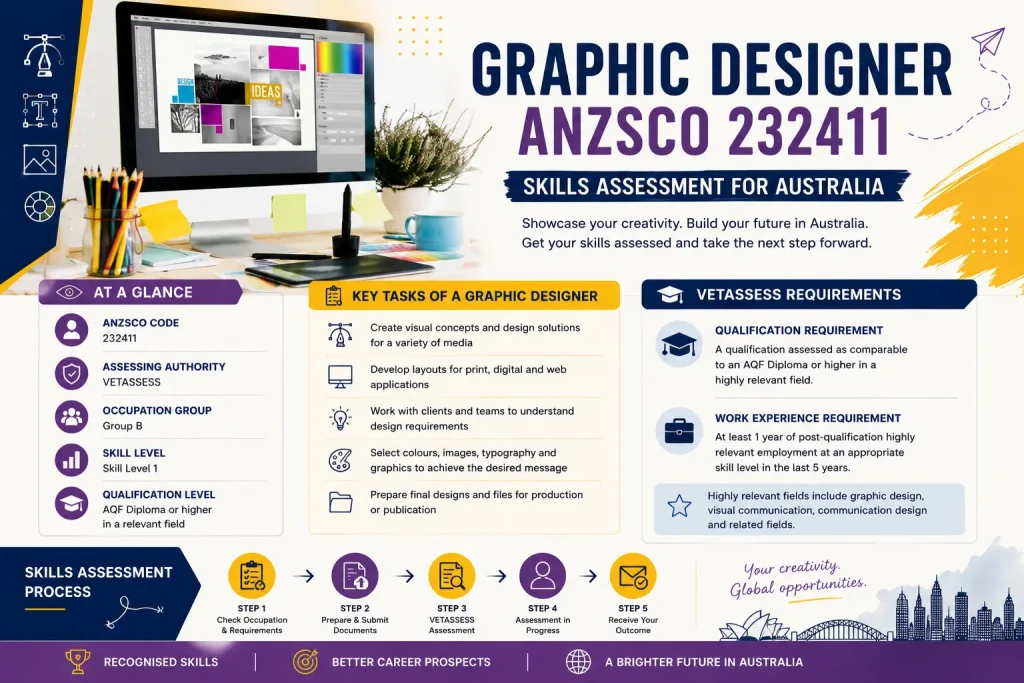
Here is a quick summary of the occupation.
Item | Details |
Occupation | Graphic Designer |
ANZSCO code | 232411 |
Assessing authority | VETASSESS |
Occupation group | Group B |
Skill level | Skill Level 1 |
Qualification level | AQF Bachelor degree or higher |
Extra requirement | Portfolio required |
Work experience needed | Depends on the pathway |
One important thing to notice is that Graphic Designer is a Group B occupation, not Group A. That matters because the assessment pathways are more flexible, but they also depend more on the combination of your degree and your work experience.
Yes. VETASSESS Skills Assessment for Graphic Designer is the official migration skills assessment pathway for this occupation.
If you want to apply under Graphic Designer ANZSCO 232411 Australia, the assessing authority is VETASSESS. Visa occupation listings for this code also show the same.
Looking for Biotechnologist ANZSCO 234514 ?
This is the part most applicants want to understand first.
For graphic designers, VETASSESS uses Group B pathways. That means the result depends on your qualification, whether the field is highly relevant, and how much relevant work experience you have.
For Graphic Designer VETASSESS Skills Assessment, you need a qualification assessed as comparable to an AQF Bachelor degree or higher.
VETASSESS lists these as highly relevant major fields of study:
VETASSESS also says that Industrial Design may be considered case by case if the degree includes relevant design units and the later employment is highly relevant to graphic design work.
This is where graphic designer is a little different from some of the other occupations.
You have:
You have:
You have:
You have:
VETASSESS also notes an important point. If your employment is not post-qualification, then five extra years of relevant employment may be required in addition to the normal requirement.
This is one of the most important parts of the assessment.
VETASSESS does not only look at your job title. It looks closely at what you actually do. So even if your title says “Graphic Designer”, your duties still need to match the occupation properly.
Highly relevant work may include:
These are the core duties VETASSESS expects to see in graphic designer roles.
One of your main secondary keywords is Graphic Designer visual communication design portfolio, and this is a very important part of the assessment.
For this occupation, VETASSESS requires a portfolio. This is not optional. The portfolio helps VETASSESS understand the kind of design work you actually do and whether your work matches a graphic designer role at the right level.
If your work includes branding, packaging, social media design, print layout, editorial design, marketing material, presentation design, signage, or campaign visuals, those examples can help show the scope of your work.
The main goal is to prove that your work is graphic design, not just general content creation or random software use.
VETASSESS lists some roles that may fit under this ANZSCO code, such as:
These titles show that the occupation is wider than just one standard office job title. What matters most is the nature of the work.
This part matters a lot because many design jobs overlap.
VETASSESS says the following are not considered under Graphic Designer 232411:
So if your work is mainly web design, animation, multimedia production, or illustration, this may not be the right occupation code.
VETASSESS gives a special note about UX and UI Designers.
It says that to be considered suitable as a Graphic Designer, the applicant should already have a strong foundation in graphic design, especially in colour, type, and layout, before moving into UX or UI work.
VETASSESS also says that if someone does not have a highly relevant qualification, has no previous graphic design employment, and is currently working only as a UX or UI Designer, they are unlikely to be considered under Graphic Designer. In that situation, they may be more suitable under Web Designer instead.
This is very important for people whose current title is UI Designer, UX Designer, or Product Designer.
Graphic designers can work in many different places depending on the type of design work they do.
VETASSESS also says graphic designers may work as sole proprietors, contract freelancers, NGOs, design houses, advertising agencies, or in-house designers for businesses that need design support.
Jobs and Skills Australia shows graphic designers working across industries such as Professional, Scientific and Technical Services, Manufacturing, and Information Media and Telecommunications.
The process becomes easier when you break it into small steps.
Step 1: Check the occupation
Read the VETASSESS occupation page and make sure your work fits Graphic Designer ANZSCO 232411 and not illustrator, web designer, or multimedia designer.
Step 2: Review your qualification
Check whether your degree is highly relevant, such as graphic design, visual communication, or communication design.
Step 3: Review your work experience
Make sure your work matches graphic designer duties and fits the correct VETASSESS pathway based on your study background.
Step 4: Prepare your portfolio
Collect strong design samples that clearly show graphic design work, not just general creative tasks.
Step 5: Collect your documents
Prepare identity, education, and employment documents before lodging the application.
Step 6: Lodge the application
Submit the VETASSESS application with all required documents and your portfolio.
Step 7: Wait for the outcome
VETASSESS will assess your qualification, employment, and portfolio evidence before giving the final result.
The exact list can vary, but most applicants should be ready with documents for identity, education, and employment.
Common documents may include:
Your employment references are very important. They should clearly mention:
If the duties are vague, your application can become harder to assess.
After getting a positive skills assessment, the next step is usually the visa pathway. One of your secondary keywords is Graphic Designer visa subclass 190 491 482, so here is a simple breakdown.
VisaEnvoy shows Graphic Designer ANZSCO 232411 linked to pathways such as:
It also shows some employer-sponsored pathways like 407 and 494, but for your keyword set the main focus is 190, 491, and 482.
This is a skilled nominated visa. You need nomination from an Australian state or territory.
This is a regional skilled visa. It is points-tested and usually needs state nomination for this occupation pathway.
This is an employer-sponsored visa. You need an Australian employer willing to sponsor you.
Visa subclass | Basic idea | Main requirement |
190 | Skilled nominated visa | State or territory nomination |
491 | Regional skilled visa | State nomination |
482 | Employer-sponsored visa | Employer sponsorship |
Here are some common mistakes that can create problems.
Graphic design, multimedia, web design, and illustration often overlap. Some applicants choose Graphic Designer when their work fits another code better.
This occupation needs a portfolio. Missing or weak design samples can hurt the application.
A title like “Designer” is not enough. Your reference letters should clearly show layout, branding, publication, visual communication, and production-related duties.
If your background is mostly UX or UI and you do not have a strong graphic design foundation, VETASSESS may not treat it as Graphic Designer work.
Graphic Designer is a Group B occupation, so your qualification and work experience need to fit one of the available pathways properly.
Graphic Designer VETASSESS Skills Assessment is a major step if you want to migrate under Graphic Designer ANZSCO 232411 Australia. The main goal is to show that your qualification, work experience, and portfolio all support the same story: that you are working as a graphic designer at the right professional level.
If your background is in graphic design, visual communication, or communication design, and your work clearly shows design brief development, layout, branding, publication work, and visual communication skills, you may have a strong starting point. Just make sure you understand the right VETASSESS pathway and prepare a strong portfolio before applying.
1. Who is the assessing authority for Graphic Designer ANZSCO 232411?
The assessing authority is VETASSESS.
2. Is Graphic Designer a Group A or Group B occupation?
Graphic Designer is a Group B occupation under VETASSESS.
3. Do I need a portfolio for Graphic Designer VETASSESS Skills Assessment?
Yes. VETASSESS says applicants nominating this occupation must submit a portfolio or provide a link to their design work.
4. What qualifications are highly relevant for Graphic Designer?
Highly relevant study areas include Graphic Design, Visual Communication, and Communication Design.
5. Can a graphic designer apply for subclass 190, 491, or 482?
This occupation is commonly linked with 190, 491, and 482 visa pathways, but the right option depends on current migration rules, nomination, sponsorship, and your own profile.
Save Up To
On your Skills Assessment!
Get Expert Guidence for your Migration Skills Assessment. Australia’s leading consultants for ACS, Engineers Australia and Vetassess and Others with a 99% success rate.
Extra Save
On Whatsapp order

Scan the QR Code with your mobile to get a Discount

Contact Us
Our Services
100% Secure
SSL Encrypted
4.9/5 Rated
We accept:
VISA
Mastercard
Stripe
Wise
PayPal
Disclaimer:
Copyright © 2020 – 2026 Skillassessmenthelp 98% Success | Trusted in 65+ Countries | 4.9/5 Rated | 100% Secure Payments


