
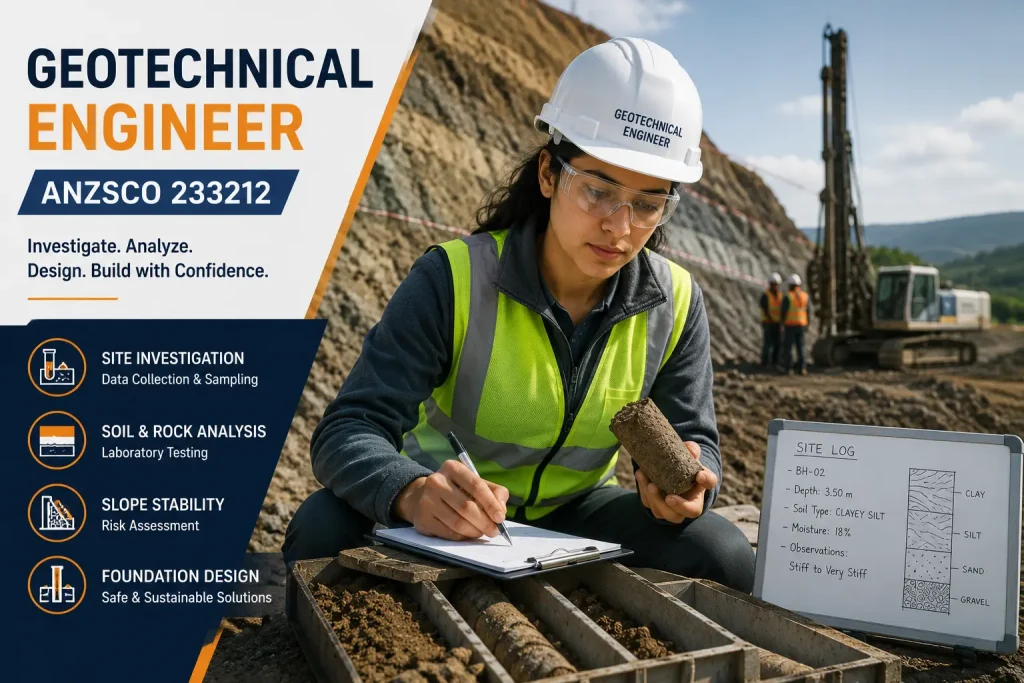
Geotechnical Engineers play an important role in making construction projects safe and stable. They evaluate ground conditions, they develop foundations and they assist engineers in minimising risks prior to construction. This guide answers your questions about occupation, ANZSCO 233212 skills assessment, visa pathways and how to migrate to Australia.
Home > Geotechnical Engineer ANZSCO 233212
Soil Analysis
Foundation Design
Site Investigation
Ground Stability
Geotechnical Engineers specialize in understanding the properties of soil, rock and ground materials to help design and construct projects. Their work is used to decide if land can be built on, for roads and bridges, dams and tunnels and other structures.
Geotechnical Engineers are included in the ANZSCO code 233212 occupation list and gather data from a site, interpret the ground conditions, suggest appropriate foundation systems, and offer technical guidance during site construction.
They will generally collaborate with Civil Engineers, Structural Engineers, surveyors, architects and construction teams to ensure projects are constructed on solid foundations.
Item | Details |
Occupation | Geotechnical Engineer |
ANZSCO Code | 233212 |
Occupation Type | Professional Engineer |
Assessing Authority | Engineers Australia |
Skill Level | Skill Level 1 |
Common Visa Pathways | 189, 190, 491, 482, 186, 494 |
Geotechnical Engineers examine the earth prior to construction. Their work minimizes the risks of engineering and assists in the development of safe project design.
Typical duties include:
Their suggestions enable the construction teams to make informed decisions before the initiation of major work.
Geotechnical Engineers are employed in many industries throughout Australia.
Common workplaces include:
Others also find employment with offshore engineering, rail projects and in large commercial developments.
Geotechnical Engineers need strong technical knowledge together with practical problem solving skills.
Important skills include:
It’s critical to pay attention to detail because a small issue on the ground can impact a large engineering project.
Many applicants search for ANZSCO 233212 skills assessment before beginning their migration process.
Engineers Australia is the official assessing authority for this occupation.
Applicants’ qualifications and engineering experience are typically used to assess them against one of the recognised Engineers Australia pathways.
Typically, the assessment examines:
Applicants who do not hold an accredited engineering qualification may need to complete the Competency Demonstration Report (CDR) pathway to demonstrate their engineering knowledge and professional experience.
Applicants should always review the latest Engineers Australia assessment requirements before submitting an application because policies may change.
Geotechnical Engineers normally hold a bachelor’s degree or higher in Engineering with a focus on geotechnical, civil, geological, or related engineering disciplines.
Relevant qualifications may include:
Your study must be relevant to the entry occupation of Geotechnical Engineer ANZSCO 233212.
Good work experience often covers tasks like:
Your work history should indicate engineering work, not technician or laboratory work.
Having comprehensive documents ready to submit when you apply can minimize delays.
Typical documents include:
Document | Purpose |
Passport | Identity verification |
Engineering degree | Qualification evidence |
Academic transcripts | Education details |
Employment reference letters | Confirms work experience |
Resume or CV | Career history |
Employment evidence | Supports claimed experience |
Candidates who apply via the CDR route may also need to submit the Engineers Australia competency papers.
Chemical Engineer ANZSCO 233111 is one of the recognised engineering occupations for skilled migration to Australia.
Employment reference letters are an important part of your skills assessment.
A good reference will contain:
Your responsibilities should help to define engineering tasks like soil investigation, foundation design, geotechnical reporting, site visits, risk assessment, technical analysis, and more.
Detailed employment references offer more of a sign than brief letters with basic employment details.
Experienced engineers are still required in the construction, mining, and infrastructure industries throughout Australia, which is why many applicants are looking for Geotechnical Engineer visa sponsorship Australia.
Employer sponsorship opportunities often depend on:
Applicants who have recognized qualifications and applicable project experience are more competitive in a sponsored application.
Many professionals ask How to migrate as a Geotechnical Engineer to Australia.
The steps can shift a bit case to case, but the process for migration usually looks like this:
Your final migration pathway depends on your qualifications, work experience, and the migration requirements at the time you apply.
There are multiple Australian visas available for Geotechnical Engineers.
Common visa options include:
Visa rules can shift, so always check the latest occupation list.
Many applications suffer from delays due to avoidable errors.
Common examples include:
Having good documentation before applying can enhance your assessment.
Before starting your application:
The right preparation can help you to prevent unnecessary delays.
Geotechnical Engineer ANZSCO 233212 offers excellent opportunities for qualified engineers who want to build a career in Australia. If your skills and experience are suitable for this occupation, an important first step is to complete the appropriate ANZSCO 233212 skills assessment with Engineers Australia. By preparing strong supporting documents and understanding the migration process, you can improve your chances of successfully working and living in Australia.
Who assesses Geotechnical Engineer ANZSCO 233212?
Engineers Australia is the official assessing authority for Geotechnical Engineer ANZSCO 233212.
Do I need a Geotechnical Engineering degree?
Applicants should usually have a recognised engineering qualification in Geotechnical Engineering, Civil Engineering, Geological Engineering or a related qualification.
Can I apply for employer sponsorship?
Yes. Geotechnical Engineer visa sponsorship Australia might be available according to the need of the employer and visa requirement.
Is work experience important?
Yes. Your work experience should be a clear record of engineering related tasks that are appropriate for the Geotechnical Engineer occupation.
What visas does a Geotechnical Engineer typically get?
This could be through one of several visas, such as subclass 189, 190, 491, 186, 482 or 494, depending on your eligibility and the visa program at the time of application.
Save Up To
On your Skills Assessment!
Get Expert Guidence for your Migration Skills Assessment. Australia’s leading consultants for ACS, Engineers Australia and Vetassess and Others with a 99% success rate.
Extra Save
On Whatsapp order

Scan the QR Code with your mobile to get a Discount

Contact Us
Our Services
100% Secure
SSL Encrypted
4.9/5 Rated
We accept:
VISA
Mastercard
Stripe
Wise
PayPal
Disclaimer:
Copyright © 2020 – 2026 Skillassessmenthelp 98% Success | Trusted in 65+ Countries | 4.9/5 Rated | 100% Secure Payments


