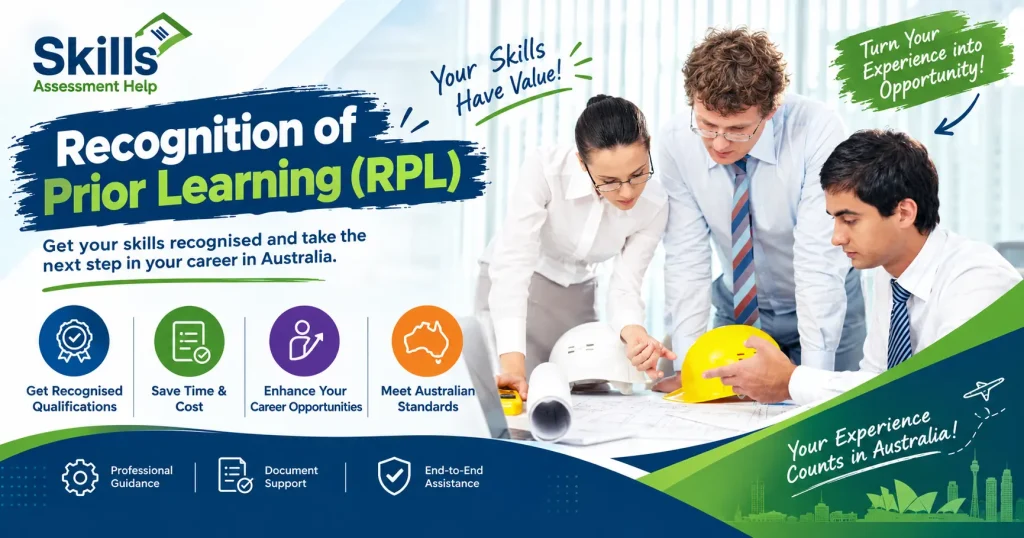
Our Recognition of Prior Learning (RPL) services are designed to help professionals understand the assessment process, organise their evidence, identify competency gaps, and prepare documentation that clearly demonstrates their existing skills and experience. Whether you have gained your expertise through years of employment, workplace training, informal learning, or previous qualifications, our professional support can help you present your experience in a structured and assessment-ready manner.
Home > Recognition of Prior Learning
Experience Assessment
Application Support
Document Support
Expert Guidance
Recognition of Prior Learning is an assessment process that evaluates what a person already knows and can do. Your knowledge does not necessarily have to come from a classroom or formal training program. Relevant skills may have been developed through workplace responsibilities, professional projects, industry experience, volunteering, self-directed learning, or other practical activities.
The purpose of RPL is to determine whether your existing knowledge and competencies meet the requirements of a particular qualification or unit. Rather than automatically receiving recognition based only on your job title or years of experience, you are required to provide appropriate evidence that demonstrates your competence.
Our RPL support services help you understand what evidence may be relevant and how to present it effectively for assessment.
RPL can be particularly useful for experienced professionals who have strong practical knowledge but do not hold a formal qualification that reflects their abilities. It may also benefit people who have worked in an industry for many years, gained skills overseas, completed informal training, or developed competencies through hands-on experience.
RPL may be suitable if you:
Every RPL assessment is individual, and eligibility depends on the requirements of the relevant qualification and the evidence available.
We provide structured assistance throughout the RPL preparation process. Our approach focuses on understanding your professional background first and then determining how your existing experience can be mapped against the relevant competency requirements.
We begin by reviewing your professional background, employment experience, previous learning, qualifications, and existing skills. This initial assessment helps establish whether RPL may be an appropriate pathway for your situation.
Understanding the competency requirements is an important part of an RPL application. We help you identify how your workplace responsibilities, projects, tasks, and professional knowledge relate to the required competency standards.
Strong evidence is central to an RPL assessment. Depending on the qualification and assessment requirements, relevant evidence may include work samples, project documentation, job descriptions, training records, previous qualifications, workplace records, references, photographs, or other supporting materials.
We help you understand what evidence may be relevant and how different documents can demonstrate your knowledge and practical skills.
Presenting information in a clear and organised format can make the assessment process easier to understand. Our team assists with structuring your information so that your experience and supporting evidence are presented logically.
RPL does not mean every applicant will automatically receive recognition for every competency. During the process, potential gaps may be identified. We help you understand these gaps so you can determine whether additional training, evidence, or assessment may be required.
Before submission, documentation can be reviewed for consistency, completeness, clarity, and alignment with the relevant assessment requirements. This helps minimise avoidable documentation issues.
RPL is based on demonstrated competence rather than simply claiming that you have particular skills. For this reason, evidence plays an important role in the assessment process.
Your evidence should demonstrate that you have the required knowledge and practical ability. It should also be relevant, authentic, current where required, and sufficient to support the competency being assessed.
For example, someone with extensive project management experience may have developed competencies through managing budgets, coordinating teams, preparing project documentation, handling risks, and communicating with stakeholders. Instead of simply stating these responsibilities, appropriate workplace evidence can help demonstrate how those competencies were actually applied.
Our Recognition of Prior Learning support focuses on helping you connect your real-world experience with the evidence required for assessment.
The RPL journey can be organised into several practical stages:
Step 1: Consultation
We learn about your professional experience, previous learning, qualifications, and career background.
Step 2: Eligibility Review
Your experience is considered against the relevant qualification or competency requirements.
Step 3: Evidence Planning
Potential evidence is identified and organised according to the required competency areas.
Step 4: Competency Mapping
Your experience and evidence are mapped to the applicable requirements.
Step 5: Documentation Preparation
Information is structured into the required RPL documentation.
Step 6: Quality Review
The documentation is reviewed for clarity, consistency, and completeness.
Step 7: Assessment
The completed evidence is submitted to the relevant registered training organisation or assessing body for formal assessment.
The final recognition decision is made by the authorised assessor or training organisation based on its assessment requirements.
Preparing an RPL application can be challenging when you are unfamiliar with competency standards, evidence requirements, or assessment documentation. Professional guidance can make the process more organised and easier to navigate.
Our service focuses on:
Rather than providing a generic document, we focus on your actual professional experience and help you understand how it can be demonstrated through suitable evidence.
Many professionals develop advanced skills through years of practical employment without completing a formal qualification at the same level. RPL can provide a pathway for those individuals to have their existing competencies formally assessed.
For experienced workers, this can be particularly valuable because repeating training in areas where they are already competent may not be the most suitable approach. RPL recognises that learning can happen in many environments, including workplaces and professional settings.
However, recognition is always dependent on assessment. Your experience must be supported by sufficient evidence and must meet the applicable competency requirements.
If you work with databases, servers, backups or data security then Database Administrator ANZSCO 262111 could be a good fit for your Australia migration.
Applicants can sometimes experience difficulties because they provide too little evidence, submit irrelevant documents, fail to connect evidence with competencies, or provide inconsistent information.
Common issues include:
Our RPL documentation support helps you approach these areas systematically and prepare information that is easier for an assessor to evaluate.
Your professional experience has value, and the skills you have developed throughout your career may provide a strong foundation for formal recognition. Recognition of Prior Learning (RPL) offers an assessment-based pathway for turning relevant knowledge and practical experience into recognised competencies where you meet the required standards.
Our team provides professional assistance with the RPL preparation process, from understanding your background and identifying relevant evidence to organising documentation and reviewing your submission.
If you are an experienced professional looking to understand whether RPL is suitable for your circumstances, contact us today. We can help you understand the process, identify the documentation you may need, and prepare your application in a structured and professional manner.
A Systems Administrator looks after the computers and IT systems in a company. They just make sure everything keeps working the way it should.
Save Up To
On your Skills Assessment!
Get Expert Guidence for your Migration Skills Assessment. Australia’s leading consultants for ACS, Engineers Australia and Vetassess and Others with a 99% success rate.
Extra Save
On Whatsapp order

Scan the QR Code with your mobile to get a Discount

Contact Us
Our Services
100% Secure
SSL Encrypted
4.9/5 Rated
We accept:
VISA
Mastercard
Stripe
Wise
PayPal
Disclaimer:
Copyright © 2020 – 2026 Skillassessmenthelp 98% Success | Trusted in 65+ Countries | 4.9/5 Rated | 100% Secure Payments


