
Biotechnologist VETASSESS Skills Assessment is one of the key steps if you want to migrate to Australia as a biotechnologist. If your occupation comes under Biotechnologist ANZSCO 234514 Australia, you will usually need a positive skills assessment before applying for a skilled visa.
The following is a simple explanation of how to do this. You will gain an understanding of the job of a biotechnologist, the VETASSESS checks they would undertake, the qualifications and work experience typically required and the visa pathways that may be available.
Home > Biotechnologist ANZSCO 234514
Genetic Research
Cell Culture
Laboratory Analysis
Bioprocess Development
A biotechnologist studies living things. This refers to cells, genes and biological molecules. They use what they learn to create or improve products and processes. This type of work is reflected in health, farming, food and environmental science.
In short, a biotechnologist uses science to fix real world problems. This may involve developing better medicines, contributing to the development of disease detection tools, researching on bacteria or enzymes, or working on the development of biological products that are useful.
VETASSESS categorizes a biotechnologist as a professional who works with the anatomy, physiology and properties of living organisms and isolated biological molecules, and who designs new materials for various applications.
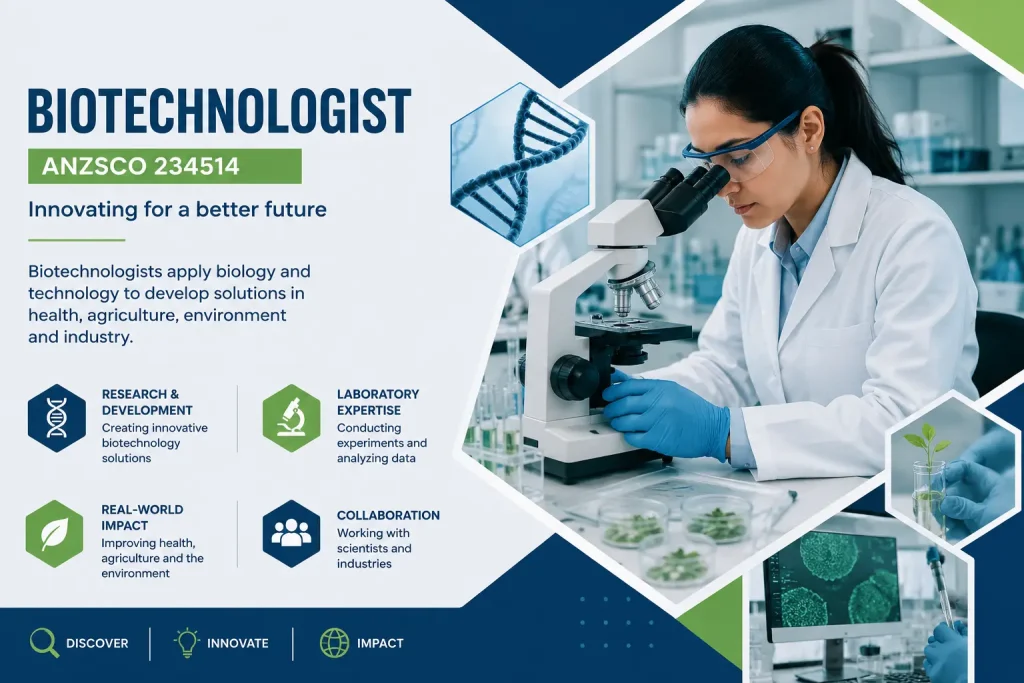
Here is a quick summary of the occupation.
Item | Details |
Occupation | Biotechnologist |
ANZSCO code | 234514 |
Assessing authority | VETASSESS |
Occupation group | Group A |
Skill level | Skill Level 1 |
Qualification level | AQF Bachelor degree or higher in a highly relevant field |
Work experience needed | At least 1 year of post-qualification highly relevant employment in the last 5 years |
VETASSESS lists Biotechnologist as a Group A occupation. Typically, applicants require an equivalent Australian qualification (Bachelor degree or above) and preferably one year of relevant post-qualification work experience.
Yes. VETASSESS Skills Assessment for Biotechnologist is the official assessment pathway for this occupation for migration purposes.
If you want to apply under Biotechnologist ANZSCO 234514 Australia, the assessing authority is VETASSESS. Visa occupation listings for this ANZSCO code also confirm the same.
Want to know more about ICT Support Engineer ANZSCO 263212 ?
It’s the part most candidates are most interested in.
For Biotechnologist VETASSESS Skills Assessment, you need a qualification assessed as comparable to an AQF Bachelor degree or higher. The qualification must also be in a highly relevant field.
VETASSESS lists highly relevant study areas such as:
Other areas of related work may also be deemed appropriate from a case to case basis, provided there are subjects in biotechnology and adequate work experience. They could be biology, microbiology, biomedicine, genetics, agriculture, zoology, chemistry, physics, and/or life science.
In addition, you must have at least 1 year of highly relevant post-qualification work experience. This work must usually be:
This is significant as VETASSESS will not just scrutinise the degree. It also examines whether your labour is actually related to biotechnologies.
One of the most crucial components of the evaluation.
VETASSESS considers your job title, but also considers your actual responsibilities. Even if your job is named “Biotechnologist”, you still need to have the correct activities.
VETASSESS also explains that biotechnologists may work in medical, industrial, agricultural, or environmental biotechnology.
One of your secondary keywords was Biotechnologist molecular biology research and it is a good match for this occupation.
Biotechnologists frequently manipulate genes, DNA, proteins, cells and molecular processes. In many instances the molecular biology aspect of the job is a significant part of the role. This may include:
VETASSESS also lists Molecular Biologist and Molecular Geneticist as specialisations under Biotechnologist ANZSCO 234514. This is a closely related occupation to molecular biology occupation.
Check out about ICT Systems Test Engineer ANZSCO 263213
Biotechnologists can work in many settings, depending on their specialisation and research area.
Biotechnologists are also listed for the Life Scientists group by Jobs and Skills Australia and they are used to study living organisms and biological molecules to develop or improve materials and processes.
It is easier to do this when you break it down into simple steps.
Step 1: Check the occupation
Read the occupation description carefully and make sure your education and work fit Biotechnologist ANZSCO 234514.
Step 2: Review your qualification
Check if your degree is closely related to biotechnology. Also make sure it is equal to an Australian Bachelor degree or higher.
Step 3: Review your work experience
Make sure your work was done after your qualification. It should be clear and apt to biotechnology work at the appropriate skill level.
Step 4: Collect your documents
Prepare your documentation that you would need for your identity, education and employment details before you begin the application.
Step 5: Lodge the application
Submit your VETASSESS application online with all the required documents.
Step 6: Wait for the outcome
VETASSESS will look at your qualification and work evidence before giving you a result.
Applicants should have documents of their identity, education, and employment; the list can change.
Common documents may include:
Your employment references are very important. A good reference letter should clearly mention:
A very short or ambiguous reference may not be the best for your application.
Once you’ve passed the skills assessment, the next step is to select the right visa. The following is a basic guide to the most popular choices.
There are a number of visa pathways associated with this occupation including:
VisaEnvoy has a visa classification of 189, 190 and 491 for the Biotechnologist occupational classification 234514.
Subclass 189
This is a skilled independent visa. It is a points test based and is not state nominated.
Subclass 190
This is a skilled nominated visa. You need nomination from an Australian state or territory.
Subclass 491
This is a regional skilled visa. It is also points-tested and needs state nomination or eligible family sponsorship in a regional area.
Visa subclass | Basic idea | Nomination needed? | Good for |
189 | Skilled independent visa | No | Applicants with strong points |
190 | Skilled nominated visa | Yes | Applicants open to state nomination |
491 | Regional skilled visa | Yes | Applicants willing to live and work in regional Australia |
Here are a few common problems that can delay or cause problems.
1) Choosing the wrong occupation
Biotechnology is related to other science areas. Some applicants may actually fit another ANZSCO occupation better.
2) Using work that is not post-qualification
For this occupation, the required work should usually be completed after your relevant qualification.
3) Sending weak job references
A letter that has only a job title is not sufficient. Biotechnology level work, as indicated in your duties, must be clearly indicated.
4) Assuming any science degree will work
All science degrees won’t be considered equally relevant. VETASSESS looks at both the field of study and the course content.
5) Confusing routine lab work with biotechnologist work
VETASSESS states this position is not a typical QC/QA, diagnostic testing or product sales position.
Biotechnologist VETASSESS Skills Assessment is a major step if you want to migrate under Biotechnologist ANZSCO 234514 Australia. The primary purpose is to demonstrate that your qualification is highly relevant and that your work experience is definitely relevant to a Biotechnologist’s job.
You have a great start if you’re from a biotechnology, molecular biology, genetics or bioinformatics background. A similar profession is also suitable. A minimum of one year work experience is also required after qualification. With that said, have your documents in order. Next, design the best visa path for you.
1. Who is the assessing authority for Biotechnologist ANZSCO 234514?
The assessing authority is VETASSESS.
2. What qualification is needed for Biotechnologist VETASSESS Skills Assessment?
You usually need a qualification equal to an AQF Bachelor degree or higher. The field of study should be closely related to biotechnology, molecular genetics, or bioinformatics.
3. How much work experience is needed?
Typically requires employment that has highly relevant work experience gained in the past year, typically 20 hours or more per week, for a minimum of 1 year.
4. Can molecular biology work fit under this occupation?
Yes. VETASSESS lists Molecular Biologist and Molecular Geneticist as specialisations under this occupation.
5. Can a biotechnologist apply for subclass 189, 190, or 491?
This occupation is associated with visa subclasses such as subclass 189 visas, subclass 190 visas and subclass 491 visas. However, the best choice is based on your points, nomination choices, and the rules when you apply.
Save Up To
On your Skills Assessment!
Get Expert Guidence for your Migration Skills Assessment. Australia’s leading consultants for ACS, Engineers Australia and Vetassess and Others with a 99% success rate.
Extra Save
On Whatsapp order

Scan the QR Code with your mobile to get a Discount

Contact Us
Our Services
100% Secure
SSL Encrypted
4.9/5 Rated
We accept:
VISA
Mastercard
Stripe
Wise
PayPal
Disclaimer:
Copyright © 2020 – 2026 Skillassessmenthelp 98% Success | Trusted in 65+ Countries | 4.9/5 Rated | 100% Secure Payments


