
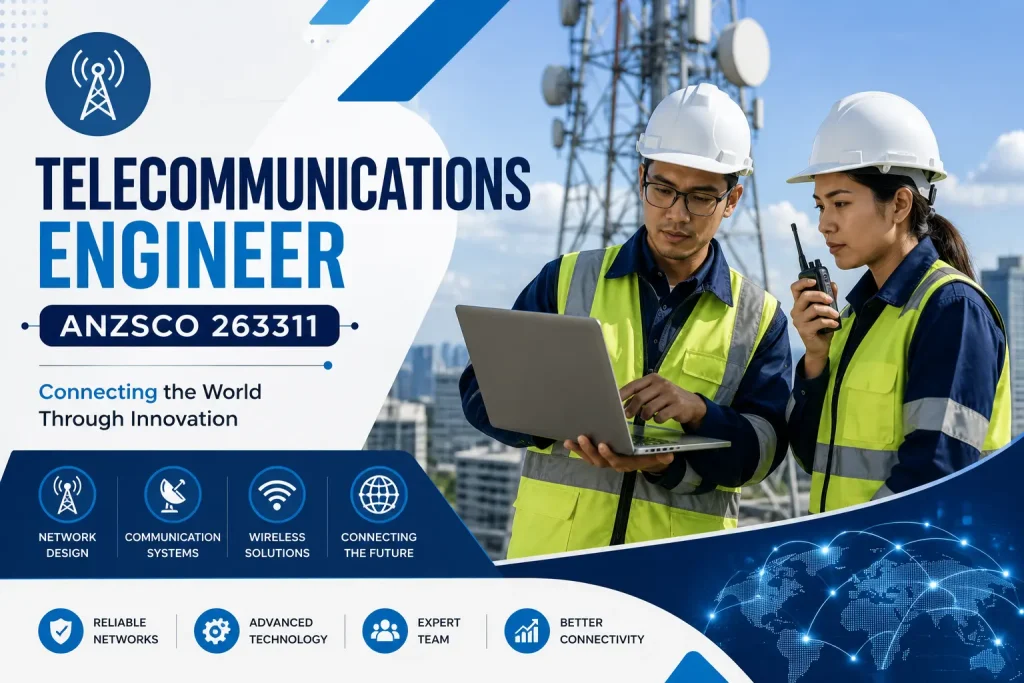
The telecommunications industry continues to play an important role in Australia’s digital economy. With the dependency of businesses and communities upon faster Internet, mobile networks, cloud services and secure communication systems, there is continuous growing demand for skilled telecommunications professionals. If you have experience designing, developing, or maintaining communication networks, Telecommunications Engineer ANZSCO 263311 may be the right occupation for your Australian migration journey.
Home > Telecommunications Engineer ANZSCO 263311
System Integration
Communication
Signal Systems
Network Design
Telecommunications Engineer plans, builds, implements and maintains communication systems and network infrastructure. They operate with technologies that facilitate a wide range of communication services such as telephony, cell phones, broadband Internet, fibre optic networks, satellite and data transmission.
Under the ANZSCO code 263311 occupation list, Telecommunications Engineers design engineering solutions, supervise installation of communication systems, improve system performance and ensure efficient operation of communication systems.
These engineers are frequently employed in coordination with Network Engineers, Electrical Engineers, Software Engineers, ICT professionals and telecommunications technicians.
Item | Details |
Occupation | Telecommunications Engineer |
ANZSCO Code | 263311 |
Occupation Type | Professional Engineer |
Assessing Authority | Engineers Australia |
Skill Level | Skill Level 1 |
Common Visa Pathways | 189, 190, 491, 482, 186, 494 |
Telecommunications Engineers design and manage systems that enable information to flow quickly and securely through communication systems.
A Biomedical Engineer applies engineering principles to medicine and biology to design, develop, test, and maintain medical equipment and healthcare technologies. They collaborate with other engineers, doctors, researchers, manufacturers or healthcare providers to design engineering solutions that facilitate improved patient care and clinical outcomes.
Typical responsibilities include:
They are responsible for communicating to businesses and communities to ensure that they have access to communication services.
Environmental Engineers are able to help to manage waste, ensure pollution is minimised and protect the water resources from pollution while ensuring any project is compliant with environmental controls.
Telecommunications Engineers are employed in many industries across Australia.
Common employers include:
Some engineers specialise in:
Successful Telecommunications Engineers combine engineering knowledge with modern communication technologies.
Important skills include:
These skills enable engineers to make efficient and reliable communication networks.
A lot of people look up ANZSCO 263311 skills assessment before they start their migration paperwork.
Engineers Australia is the authority for this occupation.
The General category: Professional Engineer is typically used to evaluate applicants. The route of assessment will be dependent on if the engineering qualification is accepted as recognised under the international engineering agreements. Once the pathway is in place, the applicant who does not have the right accreditation will follow the Competency Demonstration Report (CDR) pathway.
The assessment generally reviews:
Applicants who choose the CDR pathway typically create:
Please be sure to check with the most recent Engineers Australia assessment requirements for your submission.
Telecommunications Engineers normally hold a bachelor’s degree or higher in telecommunications or a related engineering discipline.
Relevant qualifications include:
The qualification you hold should be very similar to that required for a Telecommunications Engineer ANZSCO 263311.
Suitable employment may include responsibilities such as:
Professional engineering work, not technologist work, should show in your job description.
Getting your full set of papers ready before you apply can help the assessment move along faster.
Document | Purpose |
Passport | Identity verification |
Engineering qualification | Qualification evidence |
Academic transcripts | Educational records |
Employment reference letters | Work experience verification |
Resume or CV | Career history |
Supporting employment documents | Engineering experience evidence |
Applicants who are required to complete the CDR pathway will also be necessary to have Engineers Australia competency documents.
One of your most valuable applications are your references for work.
A good employment reference will discuss the following:
Your responsibilities should be clear and emphasize occupational engineering activities like communication system design, planning network, analysis, project management, testing, technical reporting and network optimisation.
Detailed references provide much stronger evidence than basic employment confirmation letters.
In Australia, the field of telecommunications keeps growing and there are many professionals seeking Telecommunications Engineer visa sponsorship.
Employer sponsorship opportunities often depend on:
Telecommunications infrastructure, fibre optic, mobile networks, or broadband engineers are good candidates to be suitable to apply for employer sponsored opportunities.
Many applicants ask How to migrate as a Telecommunications Engineer to Australia.
Although every application is different, the migration process generally includes the following steps:
Your pathway for migrating depends on the qualifications, employment and requirements for Australian migration at the time of application.
There are multiple lines of migration available for Telecommunications Engineers in Australia.
Common visa options include:
Everyone should check the most up-to-date occupation lists as visa status can be subject to change.
Common errors result in the loss of many applications.
Common examples include:
Preparing complete and accurate documents can improve your assessment outcome.
Before submitting your application:
If you make the correct preparations, you will prevent delays and enhance the quality of your application.
Telecommunications Engineer ANZSCO 263311 is an excellent occupation for engineers who design, develop, and manage communication systems and network infrastructure. If your qualifications and professional experience match this occupation, completing the ANZSCO 263311 skills assessment through Engineers Australia is an important step towards Australian skilled migration. Preparing strong supporting documents and understanding the migration process can improve your chances of receiving a positive assessment and achieving your migration goals.
Agricultural Engineers ANZSCO 233912 play an important role in modern farming. They plan equipment, create irrigation systems, enhance farm infrastructure, and educate and assist farmers to adopt new technologies to boost efficiency and conserve natural resources.
Who assesses Telecommunications Engineer ANZSCO 263311?
Engineers Australia is the official assessing authority for Telecommunications Engineer ANZSCO 263311.
Do I need a Telecommunications Engineering degree?
Most people who apply for this position typically have some sort of recognised bachelor’s level degree or more in telecommunications engineering or a closely related engineering field.
Can I apply for employer sponsorship?
Yes. Telecommunications Engineer visa sponsorship Australia could possibly be open depending on the employer’s need and its visa status.
Is work experience important?
Yes. Your work experience should clearly demonstrate professional telecommunications engineering duties that match ANZSCO 263311.
What are some of the popular visas for Telecommunications Engineers?
Some of the more common visa categories are Subclass 189, 190, 491, 482, 186, and 494 visa. This is dependent on your eligibility and visa requirements for Australian migration at the time.
Save Up To
On your Skills Assessment!
Get Expert Guidence for your Migration Skills Assessment. Australia’s leading consultants for ACS, Engineers Australia and Vetassess and Others with a 99% success rate.
Extra Save
On Whatsapp order

Scan the QR Code with your mobile to get a Discount

Contact Us
Our Services
100% Secure
SSL Encrypted
4.9/5 Rated
We accept:
VISA
Mastercard
Stripe
Wise
PayPal
Disclaimer:
Copyright © 2020 – 2026 Skillassessmenthelp 98% Success | Trusted in 65+ Countries | 4.9/5 Rated | 100% Secure Payments


