
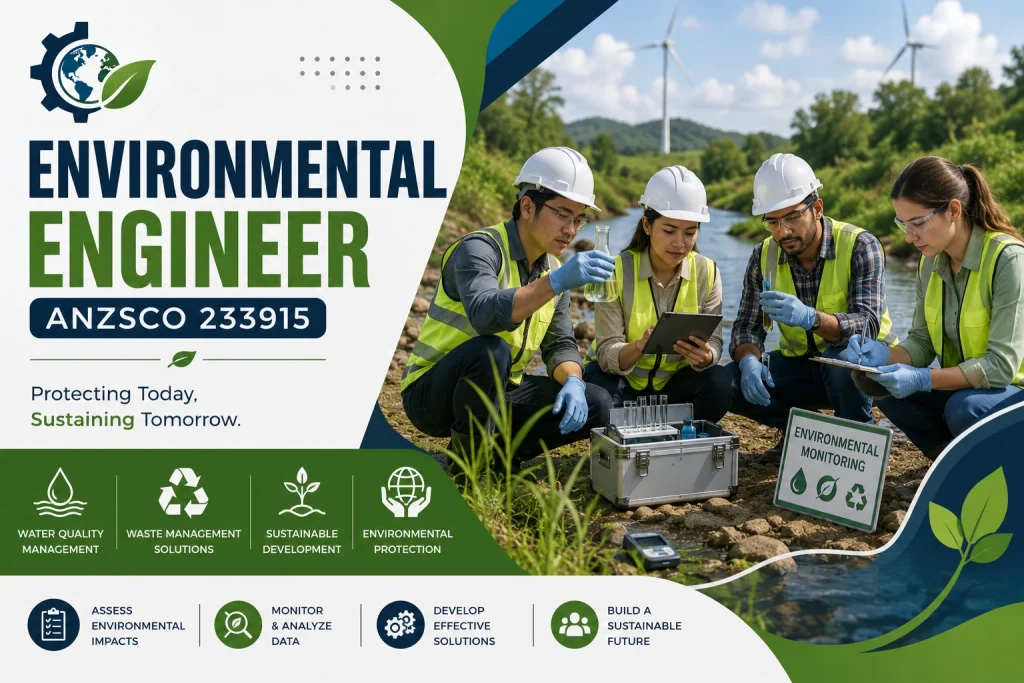
Environmental Engineers are able to help to manage waste, ensure pollution is minimised and protect the water resources from pollution while ensuring any project is compliant with environmental controls. They occupy key roles in the water, renewable energy, manufacturing, mining, construction and government industries. One of the initial steps in the migration process is in understanding how the ANZSCO 233915 Skills Assessment is conducted.
Home > Environmental Engineer ANZSCO 233915
Pollution Control
Environmental Compliance
Waste Management
Sustainability Planning
An Environmental Engineer plans, creates and implements engineering strategies to minimise environmental effects and enhance the sustainable use of the natural environment. They can evaluate environmental hazards, design pollution management techniques, oversee wastewater treatment initiatives, and guide organisations towards achieving environmental compliance.
ANZSCO 233915 occupation Environmental Engineers render environmental solutions through analysis and evaluation of environmental issues, recruit solutions to overcome environmental problems, recommend environmental and engineering strategies to influence environmental performance, or manage projects to enhance environmental quality.
They tend to interact with Civil Engineers, Chemical Engineers, Environmental Scientists, Geologists, planners, as well as government agencies.
Item | Details |
Occupation | Environmental Engineer |
ANZSCO Code | 233915 |
Occupation Type | Professional Engineer |
Assessing Authority | Engineers Australia |
Skill Level | Skill Level 1 |
Common Visa Pathways | 189, 190, 491, 482, 186, 494 |
Environmental Engineers lead in creating usable engineering solutions which promote industrial development without risk to the environment.
Typical responsibilities include:
They carry out their work in a manner that helps organisations to lower environmental risks and to comply with legal and sustainability requirements.
Environmental Engineers work across many industries throughout Australia.
Common employers include:
Some Environmental Engineers specialise in:
Environmental Engineers require strong engineering knowledge together with environmental management skills.
Important skills include:
Such abilities enable engineers to develop workable solutions to ensure the safety of people and the environment.
Many applicants search for ANZSCO 233915 skills assessment before beginning their migration application.
Engineers Australia is the official assessing authority for this occupation.
This category of occupation is assessed as Professional Engineer. The route to your assessment is dependent on your engineering qualification and where you gained it. Applicants without recognised accredited qualifications may need to complete the Competency Demonstration Report (CDR) pathway.
The assessment generally reviews:
The career episodes, summary statement and continuing professional development records are generally planned and prepared by the applicant who has completed the CDR pathway. Please see the latest Engineers Australia requirements before applying as they may change.
Typically, Environmental Engineers have a bachelor’s degree or more in Environmental Engineering or other related engineering fields.
Relevant qualifications include:
Your qualification should closely align with the occupations outlined under the ANZSCO code 233915 Environmental Engineer.
Suitable employment may include responsibilities such as:
Your job description should have obvious or overt professional engineering responsibilities and not the role of an environmental technologist or inspector.
Complete documents prepared prior to applying make it easier to approach the assessment process.
Document | Purpose |
Passport | Identity verification |
Engineering qualification | Qualification evidence |
Academic transcripts | Educational records |
Employment reference letters | Work experience verification |
Resume or CV | Career history |
Supporting employment documents | Evidence of engineering experience |
The applicant may also need to submit the competency documents which Engineers Australia requires for the CDR pathway.
One of the most crucial elements of your application is employment references.
A quality reference letter should include:
Job responsibilities should show a professional level of engineering practice including design of environmental systems, pollution controls, water treatment, engineering analysis, project management, engineering technical reporting, environmental compliance.
Detailed references are more valuable than the routine letters of reference that are only provided in confirmation of a person’s employment.
There is a need for Environmental Engineer roles that are visa sponsored in Australia, and qualified Engineers are still in demand throughout the construction and building, infrastructure, mining, water and renewable energy industries in Australia.
Employer sponsorship opportunities often depend on:
For jobs that are employer-sponsored, applicants with recognised engineering qualifications and hands-on experience of environmental engineering are more competitive.
A Biomedical Engineer applies engineering principles to medicine and biology to design, develop, test, and maintain medical equipment and healthcare technologies.
Many applicants ask How to migrate as an Environmental Engineer to Australia.
Although every application is different, the migration process generally follows these steps:
Your pathway to migration will depend on your skills, experience and the Australian migration requirements to which your application will be put when you make your application.
There are several Australian migration options available for Environmental Engineers.
Common visa options include:
Visa eligibility is subject to change and applicants are advised to always check the latest occupation lists before applying.
Most applications have delays due to preventable errors.
Some common examples include:
Preparing complete and accurate documents can improve your assessment outcome.
Before submitting your application:
Being well prepared will mean your application is ready to be submitted and is a high quality application.
Petroleum Engineers ANZSCO 233612 help energy companies find, extract, and produce oil and natural gas safely and efficiently.
Environmental Engineer ANZSCO 233915 is an excellent occupation for professionals who want to combine engineering knowledge with environmental protection. If your qualifications and professional experience match this occupation, completing the correct ANZSCO 233915 skills assessment through Engineers Australia is an important step towards Australian skilled migration. Preparing accurate documents and understanding the migration process can improve your chances of achieving a successful outcome.
Who assesses Environmental Engineer ANZSCO 233915?
Engineers Australia is the official assessing authority for Environmental Engineer ANZSCO 233915.
Is an Environmental Engineering degree necessary?
Typically applicants require a recognized bachelor’s degree or equivalent in Environmental Engineering or a related engineering field.
Can I apply for employer sponsorship?
Yes. The Environmental Engineer visa sponsorship Australia is available based on the requirement of the employers and eligibility for a visa.
Is work experience important?
Yes. Demonstration of professional environmental engineering duties in the position of employment, is clearly related to ANZSCO 233915.
What are the typical visa options for Environmental Engineers?
The most common pathway is based on the following subclasses: subclass 189, 190, 491, 482 and subclass 186 and 494 depending upon eligibility and the current Australian migration requirements.
Save Up To
On your Skills Assessment!
Get Expert Guidence for your Migration Skills Assessment. Australia’s leading consultants for ACS, Engineers Australia and Vetassess and Others with a 99% success rate.
Extra Save
On Whatsapp order

Scan the QR Code with your mobile to get a Discount

Contact Us
Our Services
100% Secure
SSL Encrypted
4.9/5 Rated
We accept:
VISA
Mastercard
Stripe
Wise
PayPal
Disclaimer:
Copyright © 2020 – 2026 Skillassessmenthelp 98% Success | Trusted in 65+ Countries | 4.9/5 Rated | 100% Secure Payments