
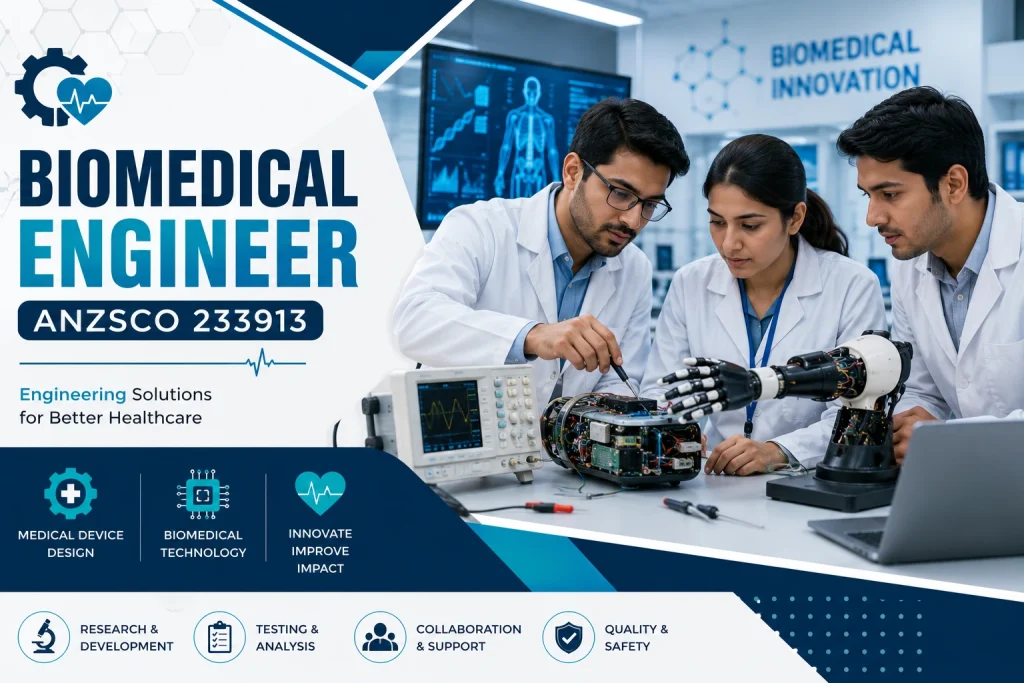
Biomedical Engineers are involved with the equipment used in healthcare businesses such as hospitals, institutions for research, rehabilitation and healthcare manufacturing. They can contribute to the design of safe, reliable and effective medical devices that aid in diagnosis, treatment and outcome of the patient. One of the initial steps in changing your profession is comprehension of the ANZSCO 233913 skills evaluation process.
Home > Biomedical Engineer ANZSCO 233913
Medical Devices
Biomedical Systems
Clinical Engineering
Device Testing
A Biomedical Engineer applies engineering principles to medicine and biology to design, develop, test, and maintain medical equipment and healthcare technologies. They collaborate with other engineers, doctors, researchers, manufacturers or healthcare providers to design engineering solutions that facilitate improved patient care and clinical outcomes.
Biomedical Engineers fit into the occupation category 233913 on the ANZSCO list, which includes these roles: Biomedical Engineer, Biomedical Mechanical Engineer, Biomedical Electronic Engineer, Biomedical Biomedical Instrumentation Engineer, Biomedical Product Development Engineer, Biomedical Biomedical Systems Engineer, Biomedical Microtechnology Engineer.
They have support roles in the hospitals, medical research, medical manufacturing and biotechnology industries.
Item | Details |
Occupation | Biomedical Engineer |
ANZSCO Code | 233913 |
Occupation Type | Professional Engineer |
Assessing Authority | Engineers Australia |
Skill Level | Skill Level 1 |
Common Visa Pathways | 189, 190, 491, 482, 186, 494 |
Biomedical Engineers develop engineering solutions that improve healthcare services and medical technology.
Typical responsibilities include:
They play a crucial role in supporting hospitals and healthcare providers to provide safe and effective care to patients.
A Mining Engineer plans, designs, and manages mining operations. They find safe and efficient ways to dig up minerals, and they minimize costs and protect workers.
Biomedical Engineers work across many sectors of the healthcare and engineering industries.
Common workplaces include:
Specialist areas include medical imaging, rehabilitation technology, biomaterials, artificial organs, prosthetics and clinical engineering.
Biomedical Engineers need a combination of engineering knowledge and medical technology skills.
Important skills include:
Strong analytical skills help Biomedical Engineers improve medical devices while ensuring patient safety.
Many applicants search for ANZSCO 233913 skills assessment before starting their migration application.
The official assessing authority in this occupation is Engineers Australia.
Your assessment pathway will be different depending on the country/city where you have qualified in engineering. Applicants with accredited engineering degrees may follow an accredited qualification pathway, while others may need to complete the Competency Demonstration Report (CDR) pathway.
The assessment generally reviews:
Those applying through the CDR pathway need to create career episodes, summary statements, and CPD records. It is important to review the latest Engineers Australia requirements before submitting your application because assessment requirements may change.
Most Biomedical Engineers have earned a Bachelor’s degree or advanced degree in Biomedical Engineering or a related engineering field.
Relevant qualifications may include:
Your qualification needs to be closely related to Biomedical Engineer ANZSCO 233913, the engineering duties that you’re likely to assume.
Suitable employment may include work involving:
Your profession as an engineer must show evidence more of your professional engineering job role and less of medical technician or equipment operator.
Planning in advance can make the assessment process a lot easier.
Document | Purpose |
Passport | Identity verification |
Engineering degree | Qualification evidence |
Academic transcripts | Educational records |
Employment reference letters | Work experience verification |
Resume or CV | Career summary |
Supporting employment documents | Evidence of engineering experience |
Applicants going through the CDR process will also need to submit competency documents required by Engineers Australia.
Reference letters count as one of the biggest parts of your application.
A good reference for work will contain:
Professional engineering activities like medical device development, engineering analysis, healthcare equipment design, technical reporting, project management, biomedical system evaluation and others should clearly show in your duties.
Detailed references are better than the standard employment confirmation letters.
Experienced Biomedical Engineers will still be in demand throughout Australia’s health, medicine technology and engineering sectors which is why many professionals seek Biomedical Engineer visa sponsorship Australia.
Employment opportunities often depend on:
Employer-sponsored positions usually favor candidates with engineering qualifications or jobs where skills in the field have been demonstrated.
Many applicants ask how to migrate as a Biomedical Engineer to Australia.
Although every application is different, the migration process generally follows these steps:
Your pathway to migration to Australia will vary based on your migration requirements, work experience and ability.
Biomedical Engineers can move into a number of Australian migration paths.
Common visa options include:
Visa eligibility may change and it is always best to check the current occupation lists before applying.
Avoidable errors result in many applicants facing delays.
Common mistakes include:
Carefully preparing your documents can improve your assessment outcome.
Before submitting your application:
Correct preparation can minimize delays, increase effectiveness of your application.
Biomedical Engineer ANZSCO 233913 is an excellent occupation for engineers who want to build a career in Australia’s growing healthcare and medical technology sectors. If your professional experience and qualifications correspond with this occupation, the first step to the ANZSCO 233913 qualification is to make the right move with Engineers Australia to undertake the correct skills assessment. By preparing accurate documents and understanding the migration process, you can improve your chances of achieving a successful outcome.
Who assesses Biomedical Engineer ANZSCO 233913?
Engineers Australia is the official assessing authority for Biomedical Engineer ANZSCO 233913.
Is it necessary to have a Biomedical Engineering degree?
Typical requirements for applicants are a recognized bachelors or higher degree in or related to Biomedical Engineering.
Can I apply for employer sponsorship?
Yes. Biomedical Engineer visa sponsorship Australia might be available depending on the sponsoring employers’ needs and the eligibility for a visa.
Is work experience important?
Yes. Your work history should clearly show real biomedical engineering duties that match ANZSCO 233913.
What are the frequently given visas for Biomedical Engineers?
Depending on who you are and what the requirements for Australian migration are, the options you can consider are Subclass 189, 190, 491, 482, 186, and 494.
Save Up To
On your Skills Assessment!
Get Expert Guidence for your Migration Skills Assessment. Australia’s leading consultants for ACS, Engineers Australia and Vetassess and Others with a 99% success rate.
Extra Save
On Whatsapp order

Scan the QR Code with your mobile to get a Discount

Contact Us
Our Services
100% Secure
SSL Encrypted
4.9/5 Rated
We accept:
VISA
Mastercard
Stripe
Wise
PayPal
Disclaimer:
Copyright © 2020 – 2026 Skillassessmenthelp 98% Success | Trusted in 65+ Countries | 4.9/5 Rated | 100% Secure Payments


