
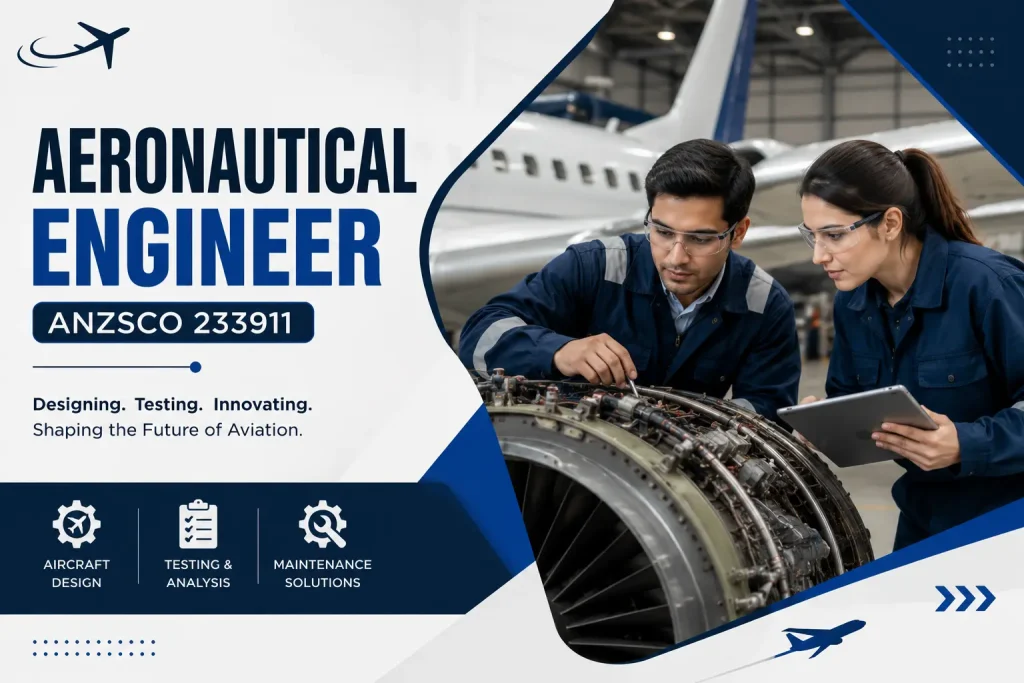
Aeronautical Engineers ANZSCO 233911 help develop safe, reliable, and efficient aircraft. They operate on commercial aircraft, military aircraft, helicopters, to include drones and aviation support systems. This guide outlines the skills assessment, migration pathways and steps involved in the process of moving to Australia for an occupation classified as ANZSCO 233911.
Home > Aeronautical Engineer ANZSCO 233911
Aircraft Design
Flight Testing
Structural Analysis
Systems Development
An Aeronautical Engineer is involved in the design, development, testing, maintenance and improvement of aircraft and aviation systems. They learn about aircraft performance, read engineering information, resolve technical issues, and ensure aircraft safety and operating requirements.
As part of the ANZSCO code 233911 occupation list, Aeronautical Engineers carry out engineering tasks associated with aircraft structures, flight systems, engines and aerospace equipment. They also manage testing, maintenance and modification activities to enhance the performance of aircraft.
They will frequently collaborate with Mechanical Engineers, Electronics Engineers, Aerospace Engineers, aviation technicians, pilots and aircraft manufacturers.
Item | Details |
Occupation | Aeronautical Engineer |
ANZSCO Code | 233911 |
Occupation Type | Professional Engineer |
Assessing Authority | Engineers Australia |
Skill Level | Skill Level 1 |
Common Visa Pathways | 189, 190, 491, 482, 186, 494 |
Aeronautical Engineers assist in the design of safe, reliable and efficient aircraft.
Typical duties include:
They help to optimize the performance of airplanes while adhering to strict safety measures, which helps the aviation industry.
Mining Engineers ANZSCO 233611 play an important role in Australia’s mining industry. They assist in the planning of mineral projects, production advancement, managing safety risks, and the efficient extraction of mineral resources.
Aeronautical Engineers have opportunities across Australia’s aviation and aerospace industries.
Common workplaces include:
Some Aeronautical Engineers also specialise in aircraft design, avionics integration, propulsion systems, structural analysis, or flight testing.
Production Engineers ANZSCO 233513 help industries improve productivity while maintaining product quality and workplace safety.
Aeronautical Engineers need strong engineering knowledge together with analytical and technical skills.
Important skills include:
An Aeronautical Engineer will benefit their aircraft’s performance by having good analytical skills to predict technical problems before they arise.
Many applicants search for ANZSCO 233911 skills assessment before starting their migration process.
Engineers Australia is the official assessing body for this occupation.
Applicants are assessed through one of the Engineers Australia assessment pathways depending on their qualifications.
The assessment generally reviews:
Applicants with no accredited engineering degree may need the CDR pathway instead. This route lets Engineers Australia look at your engineering knowledge and job background. Engineers Australia requirements are subject to change and applicants are advised to always check the current requirements before making an application.
Aeronautical Engineers normally hold a bachelor’s degree or higher in Aeronautical Engineering or another closely related engineering discipline.
Relevant qualifications may include:
Qualifications should relate to engineering and support to the engineering duties expected of an Aeronautical Engineer ANZSCO 233911.
Suitable work experience generally includes responsibilities such as:
Professional engineering duties should be evident in your work experience, not duties as an aircraft maintenance technician.
Getting your full set of papers ready before you apply can help the whole process go smoother.
Document | Purpose |
Passport | Identity verification |
Engineering degree | Qualification evidence |
Academic transcripts | Education details |
Employment reference letters | Confirms work experience |
Resume or CV | Career history |
Employment evidence | Supports claimed experience |
Competency documents as outlined by Engineers Australia may also need to be prepared by the applicant for the CDR pathway.
Reference letters count as one of the biggest parts of your application.
A good reference will contain:
Engineering tasks like aircraft design, structural analysis, flight testing, project management, technical reporting, aviation engineering duties need to be explicitly and clearly expressed in your duties.
Detailed references generally offer a better level of evidence than short reference letters of basic information.
Experienced aeronautical engineers are required in aviation, aerospace, defence and manufacturing sectors throughout Australia and many applicants are seeking aeronautical engineer visa sponsorship Australia.
Employer sponsorship opportunities often depend on:
Sponsored deals are most competitive for those who have prior engineering experience and recognised qualification.
Many professionals ask how to migrate as an Aeronautical Engineer to Australia.
Every case is a bit different, but here’s how the migration process usually plays out:
Your migration pathway depends on your qualifications, work experience, and the migration requirements that apply when you submit your application.
There are a number of Australian migration routes available for Aeronautical Engineers.
Common visa options include:
Visas are always subject to change and applicants should always check the current occupation lists.
The mistakes often cause the delay of many applications.
Some common examples include:
The audit process can be improved with fully and accurately developed records prior to application.
Before starting your application:
Proper preparation can minimize delays and enhance your application.
Aeronautical Engineer ANZSCO 233911 offers excellent career opportunities for qualified engineers who want to build a future in Australia’s aviation and aerospace industries. Engineers Australia as part of their skills assessment process is required to have the right skills assessment done under the ANZSCO 233911, if your skills and experience align with this occupation then it is a crucial first step. Careful preparation, accurate documents, and a clear understanding of the migration process can improve your chances of achieving a successful migration outcome.
Electrical Engineers ANZSCO 233311 play an important role in Australia’s energy, construction, manufacturing, telecommunications, and transport industries.
Who assesses Aeronautical Engineer ANZSCO 233911?
Engineers Australia is the official assessing authority for Aeronautical Engineer ANZSCO 233911.
Do I need an Aeronautical Engineering degree?
Aeronautical Engineer visa sponsor Australia might be available depending on the employer demand and visa requirements.
Can I apply for employer sponsorship?
Yes. Professional duties for aeronautical engineering should become evident in the work experience.
Is work experience important?
Yes. Professional duties for aeronautical engineering should become evident in the work experience.
What are the popular visas for Aeronautical Engineer?
Common pathways are: subclass 189, 190, 491, 186, 482 and 494 visa based on visa eligibility and visa programs.
Save Up To
On your Skills Assessment!
Get Expert Guidence for your Migration Skills Assessment. Australia’s leading consultants for ACS, Engineers Australia and Vetassess and Others with a 99% success rate.
Extra Save
On Whatsapp order

Scan the QR Code with your mobile to get a Discount

Contact Us
Our Services
100% Secure
SSL Encrypted
4.9/5 Rated
We accept:
VISA
Mastercard
Stripe
Wise
PayPal
Disclaimer:
Copyright © 2020 – 2026 Skillassessmenthelp 98% Success | Trusted in 65+ Countries | 4.9/5 Rated | 100% Secure Payments


