
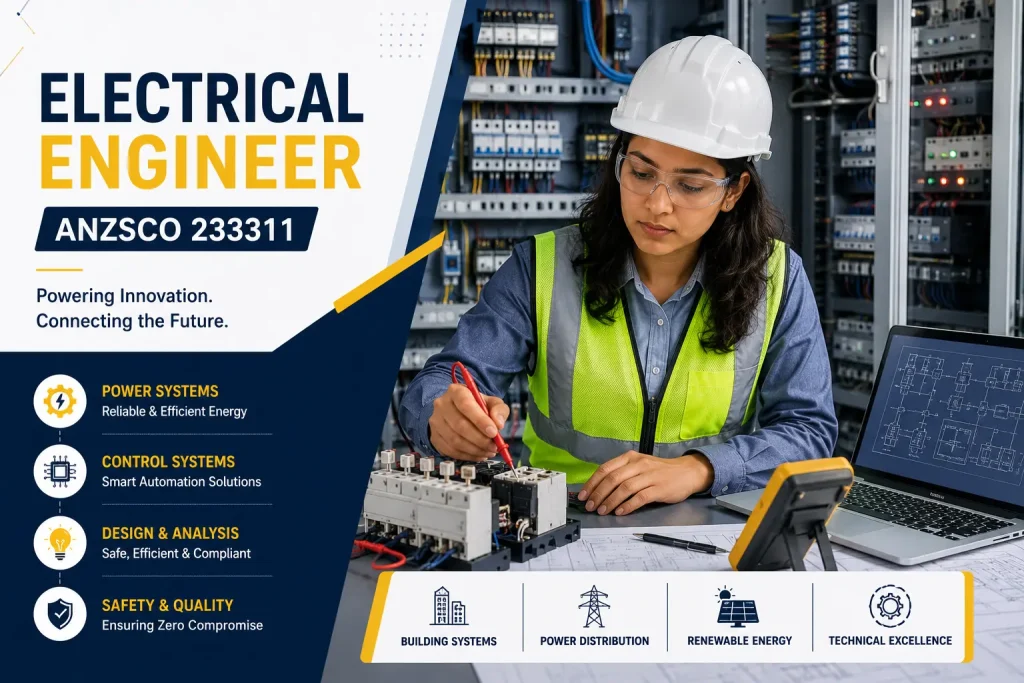
Electrical Engineers ANZSCO 233311 play an important role in Australia’s energy, construction, manufacturing, telecommunications, and transport industries. They plan safe and efficient electrical systems to power their home, business, factories and public infrastructure. This guide covers occupation, skills assessment for 233311, visa pathways and the process of migrating to Australia.
Home > Electrical Engineer ANZSCO 233311
Power Systems
Circuit Design
Electrical Testing
Energy Management
An Electrical Engineer plans, builds, implements, tests and maintains electrical equipment and electrical power systems. They work on electrical distribution networks, renewable energy systems, industrial machinery, and building services.
Electrical Engineers are included in the ANZSCO occupation list code 233311, which can assist in ensuring electrical systems run safely, efficiently and within the Australian engineering code of practice.
They often work with Mechanical Engineers, Civil Engineers, project managers, electricians, and construction teams to deliver engineering projects.
Item | Details |
Occupation | Electrical Engineer |
ANZSCO Code | 233311 |
Occupation Type | Professional Engineer |
Assessing Authority | Engineers Australia |
Skill Level | Skill Level 1 |
Common Visa Pathways | 189, 190, 491, 482, 186, 494 |
Electrical Engineers work on projects that generate, distribute, and control electrical power. They also work to make electrical equipment better and find fixes for today’s engineering problems.
Typical duties include:
They are involved in making electrical systems safer, more energy efficient, and reliable.
Electrical Engineers are employed across many industries in Australia.
Common workplaces include:
Other Electrical Engineers may have areas of specialisation, such as automation, control systems, power systems or electrical design consulting.
Electrical Engineers need strong technical knowledge together with practical engineering and problem solving skills.
Important skills include:
Electrical Engineers are proficient in analytical thought to address technical challenges and enhance system efficiency.
Many applicants search for ANZSCO 233311 skills assessment before beginning their migration journey.
In the case of this occupation, the national authority that assesses it is Engineers Australia.
Applicants typically meet one of the Engineers Australia assessment pathways that are recognised for each qualification.
Structural Engineers help create safe and durable structures that can withstand different loads and environmental conditions.
Usually the assessment entails reviewing:
If an applicant has not obtained an accredited engineering qualification, he or she may require to sit the Competency Demonstration Report (CDR) pathway. This allows Engineers Australia to assess their engineering knowledge and professional experience.
Engineers Australia’s assessment requirements should be consulted before lodging an application.
Most Electrical Engineers hold a bachelor’s degree or higher, in Electrical Engineering or another field close to it.
Relevant qualifications may include:
Your qualification should be relevant to all tasks associated with the engineering occupations in Electrical Engineer ANZSCO 233311.
Suitable work experience generally includes responsibilities such as:
You should have lots of evidence of engineering, not just electrician or technician related work.
Geotechnical Engineers play an important role in making construction projects safe and stable.
Getting your papers ready early can make the assessment go smoother.
Typical documents include:
Document | Purpose |
Passport | Identity verification |
Engineering degree | Qualification evidence |
Academic transcripts | Education details |
Employment reference letters | Confirms work experience |
Resume or CV | Career history |
Employment evidence | Supports claimed experience |
Candidates who apply for the CDR pathway might also require documentation of competency as requested by Engineers Australia.
Your reference letters from work count as one of the biggest parts of your application.
A good reference will contain:
Your responsibilities ought to include engineering tasks like electrical design, power system analysis, equipment testing, project management, fault investigation, and technical reports.
Letters of reference are typically more convincing when you have a lot of detail as opposed to a limited sentence.
The demand for Electrical Engineers in the energy, construction, manufacturing and infrastructure sectors in Australia remains high, which is why many job seekers are seeking Electrical Engineer visa sponsorship to Australia.
Employer sponsorship opportunities often depend on:
Sponsored offers are most likely to be successful for those with recognised qualifications and relevant engineering experience.
Many professionals ask how to migrate as an Electrical Engineer to Australia.
The steps can shift a bit case to case, but the process for migration usually looks like this:
Your migration route will be determined based on your skills, experience and the requirements for migration at the time of your application.
There are a variety of Australian migration options available to Electrical Engineers.
Common visa options include:
It is important for applicants to check the most up-to-date occupation lists, as eligibility for visas may change.
A Chemical Engineer plans, develops, and optimizes processes to transform raw materials into valuable products.
Too many applications are put on hold due to preventable errors.
Some common examples include:
Take time to prepare full and accurate documentation in advance to gain a better assessment process.
Before starting your application:
Proper preparation will minimize delays and enhance your application.
Electrical Engineer ANZSCO 233311 offers excellent opportunities for qualified engineers who want to build a successful career in Australia. The first step if you have the right qualifications and work experience to undertake this occupation is to get the right skill assessment completed by Engineers Australia in accordance with the ANZSCO 233311 skill assessment category. By preparing accurate supporting documents and understanding the migration process, you can improve your chances of successfully working and living in Australia.
Materials Engineers assist industries in creating materials that are more durable, safe, and dependable for various materials and projects. They can be found in a wide variety of industries, including manufacturing, mining, construction, aerospace, automotive, and more.
Who assesses Electrical Engineer ANZSCO 233311?
Engineers Australia is the official assessing authority for Electrical Engineer ANZSCO 233311.
Do I need an Electrical Engineering degree?
Those applying are typically expected to have a recognised bachelor’s degree or equivalent in a related field of engineering, such as Electrical Engineering.
Can I apply for employer sponsorship?
Yes. It may be possible to sponsor Electrical Engineer visas in Australia based on employer demand and visa visa requirements.
Is work experience important?
Yes. Your engineering responsibilities should clearly include Engineering with the Electrical Engineer occupation.
What could be the most popular visa options for Electrical Engineer?
Common pathways include Subclass 189, 190, 491, 186, 482, and 494, depending on your eligibility and the current Australian migration program.
Save Up To
On your Skills Assessment!
Get Expert Guidence for your Migration Skills Assessment. Australia’s leading consultants for ACS, Engineers Australia and Vetassess and Others with a 99% success rate.
Extra Save
On Whatsapp order

Scan the QR Code with your mobile to get a Discount

Contact Us
Our Services
100% Secure
SSL Encrypted
4.9/5 Rated
We accept:
VISA
Mastercard
Stripe
Wise
PayPal
Disclaimer:
Copyright © 2020 – 2026 Skillassessmenthelp 98% Success | Trusted in 65+ Countries | 4.9/5 Rated | 100% Secure Payments


