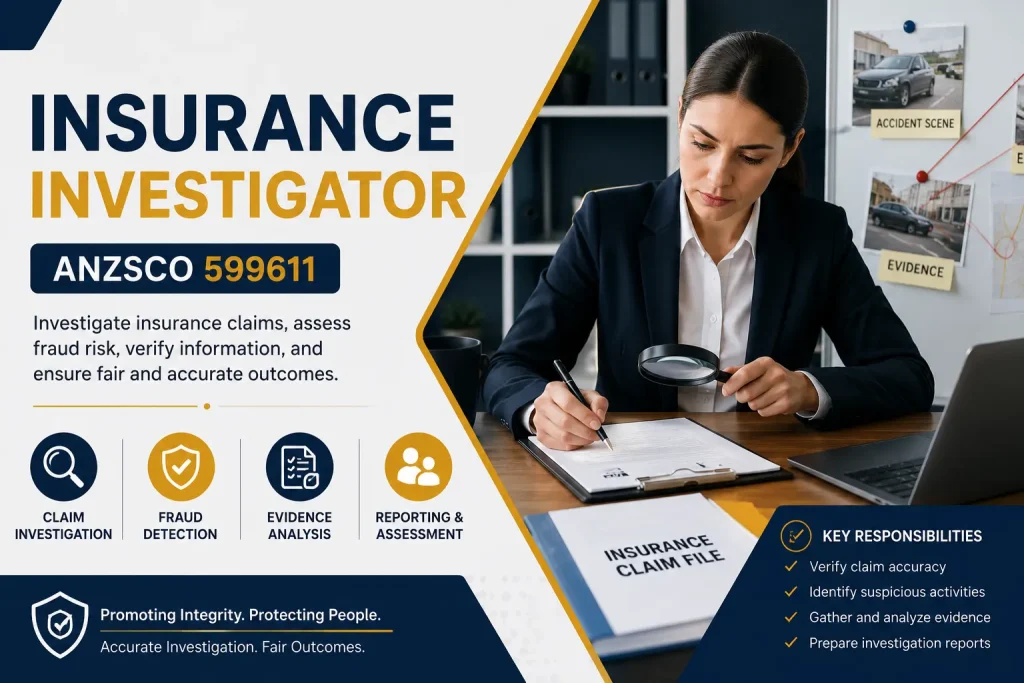
Insurance Investigator Australia 599611 is a migration occupation for people who investigate insurance claims and want to move to Australia through a skilled pathway. This occupation might be a good match for you if you’re interested in verifying claims, assessing damages, interviewing claimants and witnesses, and creating investigation reports.
Home > Insurance Investigator ANZSCO 599611
Case Analysis
Evidence Collection
Claims Review
Fraud Detection
An Insurance Investigator conducts investigations into insurance claims to make sure they are valid. This occupation sits in ANZSCO unit group 5996, which also includes Insurance Loss Adjusters and Insurance Risk Surveyors, but Insurance Investigator is its own separate occupation.
To put it simply, the task is to determine what truly took place in an insurance claim. This could involve investigating collision sites, interviewing witnesses, inspecting the damage, and preparing Collision Reports for insurance companies.
Item | Details |
Occupation | Insurance Investigator |
ANZSCO code | 599611 |
Assessing authority | VETASSESS |
VETASSESS group | Group D |
Skill level | Skill Level 3 |
Main work area | Insurance claims investigation |
Common visa pathways linked in migration sources | 189, 190, 491 and some employer pathways |
Insurance Investigator skilled migration is assessed by VETASSESS. VETASSESS places this occupation in Group D.
This is important because the qualifications and employment pathway for Group D jobs are different from Group A, B and C jobs. VETASSESS looks closely at:
Your job title isn’t sufficient, either. The duties, documents and employment evidence should correspond with the occupation.
Yes. Insurance Investigator ANZSCO 599611 is a Group D occupation under VETASSESS.
This is significant as the formal qualification level of Group D occupations is generally less than that of professional occupations, but the work evidence must be good and clearly aligned with the ANZSCO duties. This is particularly important for applicants seeking assessment as a Community Arts Worker, where demonstrated community engagement and relevant work experience play a key role in meeting the occupation requirements.
VETASSESS has several potential routes to undertake Insurance Investigator Australia 599611. The path will rely on your qualification level and the degree of relevance of your field of study.
Pathway | Qualification | Work experience needed |
Pathway 1 | An AQF Certificate IV in a field close to the job | 1 year at least of related work, after your degree, within the past 5 years |
Pathway 2 | AQF Certificate IV in a non-relevant field | At least 2 years of highly relevant post-qualification work in the last 5 years |
Pathway 3 | An AQF Certificate III in a field close to the job | At least 3 years of highly relevant post-qualification work in the last 5 years |
For Insurance Investigator 599611, migration sources linked to VETASSESS list these highly relevant fields of study:
Therefore if you are studying in one of those areas, your qualification might be more easily matched with the occupation. If you do not qualify in these areas, it is possible you might qualify elsewhere, however typically you will be required to use the pathway which is more relevant to your employment.
This is the most important part of the assessment.
Sources for VETASSESS and ANZSCO only consider the actual work activities you perform, not the job title. The main responsibilities for Insurance Investigator, ANZSCO 599611 are:
Generally, your job should be to:
If your business is predominantly insurance sales, underwriting, broking or claims administration but not actually doing any investigations work, this code may not apply to you.
It is here where many applicants get confused. There are many occupations that require insurance and many that do not, but they are not necessarily the same for migration.
Insurance Investigator is not the same as:
An Insurance Investigator is tasked with determining whether a claim is authentic and to investigate the cause of a loss. An Insurance Broker sells insurance, while an Insurance Agent represents an insurer in selling policies. An Insurance Loss Adjuster concentrates more on the damage and claim costs, whereas an Insurance Risk Surveyor focuses on risk conditions and underwriting issues. Similar to how a Software Engineer ANZSCO 261313 is assessed against specific professional duties and skill requirements, each insurance occupation has its own distinct responsibilities and assessment criteria.
Before nominating this code, be sure that daily work is truly investigation and claim validation.
If you are applying for VETASSESS skilled migration as an insurance investigator, you should clearly demonstrate your work in an insurance investigation in your application.
Your evidence should ideally show that you:
Your reference writing will be too general if it simply states that you “handled insurance claims” and “worked in insurance operations. VETASSESS must have the ability to perform investigations in addition to general insurance.
For a VETASSESS application, the usual documents include:
Since this is an investigation type of occupation, additional documentation reinforcing the nature of your occupation can also help. For example:
The secret is to not send random papers that are unnecessary. It is to send in proper documentation to clearly show that you’re a job that aligns with Insurance Investigator Blue and Unblue 599611.
This is one of the larger components of the application.
The good reference letter should contain:
The duties should mention tasks such as:
If the letter is too general, VETASSESS may not be able to see that your work matches the ANZSCO code.
The most common migrations source associations for this visa are with the skilled and employer visa streams:
As it’s in your keyword list, it is important to state this clearly and unapologetically, extra documents can and will be subject to changes in visa availability, occupation lists and the government’s nomination criteria. So before making a final migration plan, always check the latest settings for the year you apply.
People who look up Insurance Investigator PR Australia often look for information about possible permanent migration.
In a simple way, a normal path is displayed in this fashion:
So yes, this job can be part of a plan to move to Australia. But a positive skills assessment is only one step. You still need to adhere to the visa regulations prevailing at the time of application.
Insurance Investigators is an occupation profile in Australia recognized by Jobs and Skills Australia. The page shows about 400 people working in this job. Out of these, 71% work full time hours. Most work in Financial and Insurance Services, or in Public Administration and Safety.
This labour market data is useful for background. The major challenge without migration, however, is finding that your work history and activities are aligned with the VETASSESS requirements for the job you want.
1) Choosing the wrong insurance occupation
Many candidates are involved in the insurance industry, however not every insurance occupation would fit this code. Being an Insurance Salesperson, Broker, Underwriter, or Claims Admin does not qualify you as an Insurance Investigator.
2) Sending weak reference letters
Some letters do not leave a clear impression of investigation, interview, inspection, evidence gathering and reporting duties and may look too generalized and broad.
3) Focusing only on job title
The job titles such as “Claims Officer” and “Insurance Executive” will not establish proof of the occupation because they may be ambiguous. VETASSESS looks at the actual tasks.
4) Not showing the right employment evidence
Many discussions about migration highlight that one aspect of skill assessment that often creates a problem is the mismatch between employment evidence and roles, duties and responsibilities listed on letters, payslips and job applications.
5) Using a job that fits Loss Adjuster or Broker instead
A difference about insurance investigator is that it is a separate job. Other ANZSCO codes may be more applicable if your work more closely relates to adjusting losses or selling insurance, or surveying risk.
This job could be a solid pick for migrating, if your background lines up with insurance investigation work. VETASSESS would like to see the appropriate qualification pathway, as well as hands-on experience with claim work, evidence collection, interview, inspections, and reporting.
If your job matches with Insurance Investigator ANZSCO 599611, and your documents substantiate your time, you might have a strong foundation for Insurance Investigator skilled migration. To have robust reference letters, to ensure that job duties are defined well, and to verify that the right ANZSCO code is used before lodging the assessment.
1) Who assesses Insurance Investigator ANZSCO 599611?
The assessing authority is VETASSESS.
2) Is Insurance Investigator a Group C or Group D occupation?
It is a Group D occupation under VETASSESS.
3) What qualification is needed for an Insurance Investigator?
The usual path needs an AQF Certificate III or IV. This should fit the job, along with related work done after finishing the course.
4) What are the highly relevant fields of study for an Insurance Investigator?
Commonly listed highly relevant fields include General Insurance, Loss Adjusting, Security, Risk Management, and Business.
5) What kind of work counts as highly relevant?
These are the core tasks tied to the job. This means checking the scene of an incident, talking to claimants or witnesses, looking at damage, working out losses, and writing reports for insurers.
Save Up To
On your Skills Assessment!
Get Expert Guidence for your Migration Skills Assessment. Australia’s leading consultants for ACS, Engineers Australia and Vetassess and Others with a 99% success rate.
Extra Save
On Whatsapp order

Scan the QR Code with your mobile to get a Discount

Contact Us
Our Services
100% Secure
SSL Encrypted
4.9/5 Rated
We accept:
VISA
Mastercard
Stripe
Wise
PayPal
Disclaimer:
Copyright © 2020 – 2026 Skillassessmenthelp 98% Success | Trusted in 65+ Countries | 4.9/5 Rated | 100% Secure Payments


