Community Arts Worker VETASSESS Skills Assessment is a key step if you want to migrate to Australia under this occupation. As a Community Arts Worker ANZSCO 272611 Australia, you will begin your work career with a positive skills assessment before taking the next step to the visa process.
This guide covers the role in an easy-to-understand manner. You’ll find out what a Community Arts Worker does, how VETASSESS assesses this occupation, the usual qualifications and experience required, highly relevant duties, and the usual visas associated with this occupation.
Home > Community Arts Worker ANZSCO 272611
Community Engagement
Arts Programs
Cultural Development
Project Coordination
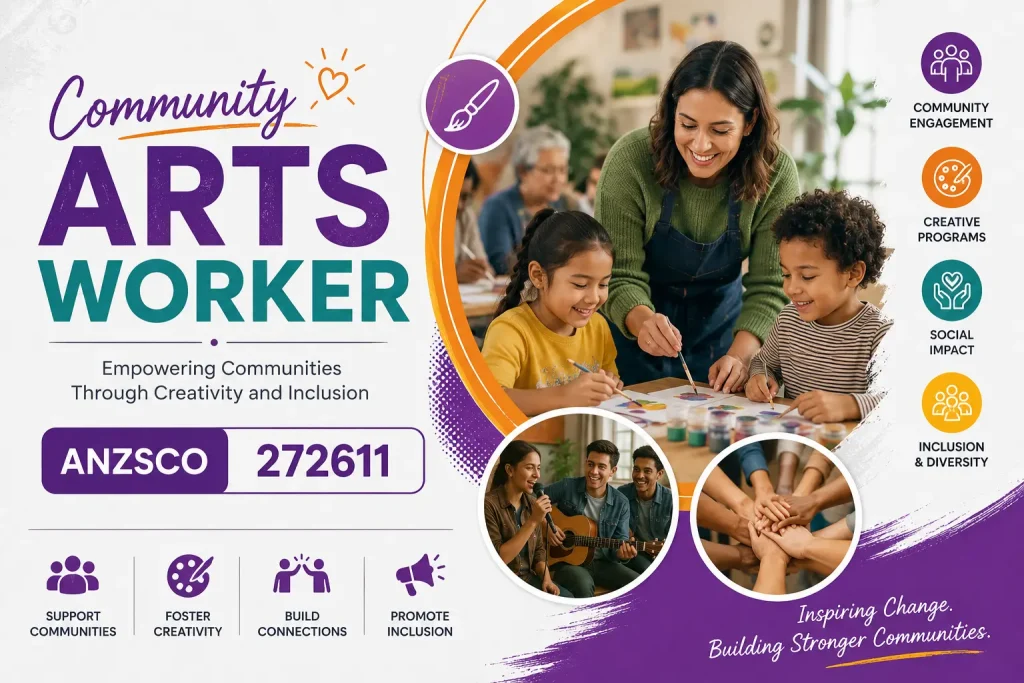
A Community Arts Worker identifies local community needs, concerns, and goals through consultation. Then they plan and carry out arts projects, cultural programmes and creative activities which enable them to participate in community life and promote cultural development in their community.
Put simply, this role brings people together, nurtures communities, and drives positive change in the local community through the medium of art. This is why this role aligns well with the Cultural development arts programs found in Community Arts Worker roles. Creating art is not the only thing it’s about. It is the idea of integrating art in the community and making people feel a part of something, having their say, and strengthening community engagement.
If you are exploring other skilled occupations, you can also learn about the requirements and career pathway for the Importer Exporter ANZSCO 133311 occupation in Australia.
Item | Details |
Occupation | Community Arts Worker |
ANZSCO code | 272611 |
Assessing authority | VETASSESS |
VETASSESS group | Group B |
Skill level | Skill Level 1 |
Main role | Designing and running community arts and cultural development programs |
Common visa pathways | 190, 491, 494 |
Is Community Arts Worker assessed by VETASSESS?
Yes. VETASSESS Skills Assessment for Community Arts Worker is the official skills assessment pathway for this occupation. VETASSESS lists Community Arts Worker 272611 as a Group B occupation.
Because group B occupations have established occupation qualification and employment pathways, and because that’s important. Your degree, field of study, and work experience all need to line up with the occupation for a positive result.
This is the first thing that everyone wants to know about.
For Community Arts Worker VETASSESS Skills Assessment, VETASSESS says the occupation requires a qualification comparable to an AQF Bachelor degree or higher. It then gives four possible pathways depending on how relevant your study is and how much highly relevant work experience you have.
Pathway | Qualification situation | Employment needed |
Pathway 1 | A bachelor degree, or something higher, in a field close to the job | 1 year at least of related work, after your degree, within the past 5 years |
Pathway 2 | Bachelor degree or higher in a not highly relevant field + extra Diploma level or higher qualification in a highly relevant field | At least 2 years of highly relevant post-qualification work in the last 5 years |
Pathway 3 | Bachelor degree or higher in a not highly relevant field | At least 3 years of highly relevant post-qualification work in the last 5 years |
Pathway 4 | Bachelor degree or higher with or without a highly relevant major | At least 6 years of employment at an appropriate skill level, including 1 year of highly relevant work in the last 5 years |
VETASSESS also expects the work to be at the right skill level, highly relevant to the occupation, and usually 20 hours or more per week.
Community Arts Worker 272611 is a Group B occupation under VETASSESS.
This is relevant because Degree Based occupations are occupations in Group B, however, the pathway can vary based on the relevance and experience acquired following the Degree.
VETASSESS lists these as highly relevant major fields of study:
The following fields are logical choices since the position falls between arts practice and community development. A Creative and Community Engagement Worker is likely to have to work both creatively and with community groups, volunteers, councils, youth groups or cultural organisations.
Community Arts Worker cultural development arts programs is one of your primary secondary keywords and again it rings true, and this is where the heart of this occupation lies.
People do not sit around all day long to do art, they don’t do it out of “pure pleasure,” as they say in French. Typically the position is specifically centered on community cultural development. This includes delivering arts programming to address local needs, engaging participation and people with creative process, and supporting participation, identity, inclusion and local culture.
In reality, this position may encompass:
The position, therefore, includes community engagement, program planning, arts delivery and cultural development endeavors.
This is a critical component of the assessment.
VETASSESS doesn’t only consider your job title. Displays what you actually do in a day-to-day basis. For Community Arts Worker ANZSCO 272611, highly relevant tasks include:
VETASSESS also says additional tasks may include:
If your work clearly includes most of these duties, it is much more likely to be treated as highly relevant by VETASSESS.
VETASSESS says Community Arts Workers may work in many different community settings. These can include:
The role might also be found in cultural institutions, community development programmes, social schemes, and local arts schemes. What matters is that there is a link between arts practice and doing work in the community and culture.
VETASSESS says the following occupations are considered suitable under Community Arts Worker 272611:
This helps because some applicants may have one of these titles rather than the exact title “Community Arts Worker”.
VETASSESS says the following roles are not considered suitable under Community Arts Worker 272611:
It’s important because there are some of these occupations that are very similar to the community arts and some are different and not treated the same way.
One thing you need to know is this.
A Community Arts Worker is not just someone who makes art or teaches art privately. The role is about using art in a community setting to support local cultural development and participation. Typically involves more of a community consultatability or community program, or public or group practice activity than individual practice.
While community-focused occupations encourage cultural participation and social engagement, professionals interested in technology and client relationship management may also explore the ICT Account Manager ANZSCO 225211 occupation pathway in Australia.
This occupation is suitable if you:
If you primarily:
According to the national data from Jobs and Skills Australia, 184 females and 400 males are workers in Community Arts in Australia, making a 74% female participation rate and 49% part-time participation rate, with a median age of 43.
This isn’t a determinant for success in migration, however it is a quick assessment of the labour market situation in Australia.
The usual requirement for all VETASSESS occupations is evidence of identify, qualifications and employment.
Common documents may include:
The documents you submit should be clearly helpful to demonstrating your qualification and employment claim. VETASSESS assesses both.
References are very significant for this occupation as VETASSESS must be satisfied that your overall work was in community arts and cultural development (not general arts activity).
Generally, a good reference letter will contain:
Letters stating “artist” or “arts teacher” alone may not be explicit enough to provide support for this occupation, if the arts side of the job is not clearly represented.
Once a successful skills assessment is complete, the next stage will typically be the visa pathway. One of your secondary keywords is Community Arts Worker visa subclass 190 491 494, so here is the simple version.
Community Arts Worker ANZSCO 272611 is often associated with visa subclasses including:
Visa requirements are ever-changing and some individuals may not be suitable for each visa pathway. However, these are the visa subclasses most popular for this field of work in migration content.
Subclass 190: This is a skilled nominated visa. Normally a nomination from an Australian state or territory is required.
Subclass 491: This is a regional skilled visa. It is points-tested and usually needs state nomination or another eligible pathway.
Subclass 494: This is a regional employer-sponsored visa. An appropriate employer in which is located is required who is prepared to sponsor you.
Visa subclass | Basic idea | Main requirement |
190 | Skilled nominated visa | State or territory nomination |
491 | Regional skilled visa | State nomination or another eligible pathway |
494 | Regional employer-sponsored visa | Employer sponsorship in regional Australia |
Here are some common problems that can weaken a Community Arts Worker application.
1) Using a creative title without enough community development duties
It may not match occupations that are primarily as an artist, performer, or teacher, but don’t have much community program work.
2) Not showing community consultation
This is not an all about workshop job. VETASSESS also expects community consultation; work on community needs and cultural development.
3) Sending vague reference letters
Problems can arise if a short letter of a creative job title, but with no clear responsibilities. VETASSESS needs to see the real tasks.
4) Not showing funding, reporting, or program work
Some of the tasks which you may have as a Community Arts Worker include reporting, funding submissions, event planning, budgets, or program coordination. The information is useful for an accurate representation of the occupation.
5) Choosing the wrong occupation code
It is possible some applicants may be best classified under another arts, recreation, teaching, or welfare occupation, based on their daily activities.
Community Arts Worker VETASSESS Skills Assessment is a key step if you want to migrate under Community Arts Worker ANZSCO 272611 Australia. What VETASSESS really wants to see is that any background you have is related to community arts, cultural development and the delivery of arts programs and that you have actual responsibilities that involve engaging with community, planning, reporting, and events.
You might have a starting-point if your work involves community arts programs, community needs assessment, organising cultural activities, report writing and/or funding applications and if you use arts to engage communities in activities. The most effective approach is to have clear documentation demonstrating community arts, as it relates to the occupation.
Who is the assessing authority for Community Arts Worker ANZSCO 272611?
The assessing authority is VETASSESS.
Is Community Arts Worker a Group A, B, or C occupation?
Community Arts Worker 272611 is a Group B occupation under VETASSESS.
What qualification level is needed for a Community Arts Worker?
VETASSESS requires a qualification comparable to an AQF Bachelor degree or higher for this occupation.
What are the highly relevant fields of study for Community Arts Worker?
VETASSESS lists Visual and Performing Arts, Community Education, Community Culture, and Aboriginal and/or Torres Strait Islander Cultural Arts as highly relevant fields.
Can Community Arts Worker apply for subclass 190, 491, or 494?
This occupation is associated with visa sub-class 190, 491 and 494 visa in migration sources, but which visa is most applicable will depend on the current migration rules as well as your profile.
Save Up To
On your Skills Assessment!
Get Expert Guidence for your Migration Skills Assessment. Australia’s leading consultants for ACS, Engineers Australia and Vetassess and Others with a 99% success rate.
Extra Save
On Whatsapp order

Scan the QR Code with your mobile to get a Discount

Contact Us
Our Services
100% Secure
SSL Encrypted
4.9/5 Rated
We accept:
VISA
Mastercard
Stripe
Wise
PayPal
Disclaimer:
Copyright © 2020 – 2026 Skillassessmenthelp 98% Success | Trusted in 65+ Countries | 4.9/5 Rated | 100% Secure Payments


