
Chemist VETASSESS Skills Assessment is one of the main steps if you want to migrate to Australia as a chemist. To apply for a skilled visa as a Chemist ANZSCO 234211 Australia, it is likely you’ll need a positive skills assessment before applying.
This guide will leave it as simple as possible. You will get an understanding of what a chemist looks like, what VETASSESS assesses, typical qualifications and experience required, and the visa options that may apply to this role.
Home > Chemist ANZSCO 234211
Quality Control
Research Development
Laboratory Testing
Chemical Analysis
A chemist is a scientist who works with the chemical and physical characteristics of matter. It may involve testing materials, conducting laboratory tests, verifying chemical reactions and assisting in the development of products or manufacturing processes.
In simple terms, a chemist observes the properties of matter, their composition and their usefulness in a functional way. The chemist might be employed in research, quality control, product testing, manufacturing or industrial production, depending on the type of work.
VETASSESS describes a chemist as a professional who studies the chemical and physical properties of substances and develops and monitors chemical processes and production.
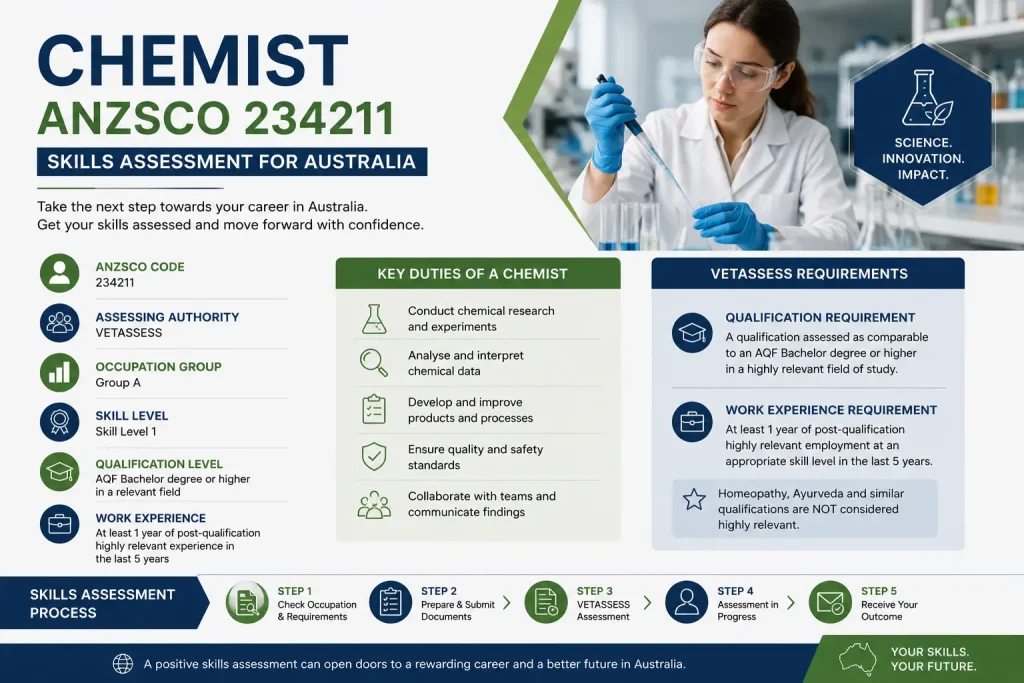
Here is a quick summary of the occupation.
Item | Details |
Occupation | Chemist |
ANZSCO code | 234211 |
Assessing authority | VETASSESS |
Occupation group | Group A |
Skill level | Skill Level 1 |
Qualification level | AQF Bachelor degree or higher in a highly relevant field |
Work experience needed | At least 1 year of post-qualification highly relevant employment in the last 5 years |
VETASSESS lists Chemist as a Group A occupation. The minimum qualification required for applicants is normally an equivalent qualification to an Australian Bachelor degree and a minimum of 1 year of post qualification, highly relevant work experience.
Yes. VETASSESS Skills Assessment for Chemist is the official migration skills assessment pathway for this occupation.
If you want to apply under Chemist ANZSCO 234211 Australia, the assessing authority is VETASSESS. Visa occupation sources for this ANZSCO code also confirm the same.
This is the part most applicants want to understand first.
1) Qualification requirement
For Chemist VETASSESS Skills Assessment, you need a qualification assessed as comparable to an AQF Bachelor degree or higher. The qualification also needs to be in a highly relevant field.
VETASSESS lists highly relevant major fields such as:
Chemistry
Medicinal Chemistry
Applied Chemistry
Biochemistry
VETASSESS also points out that qualifications with a strong chemistry major may be evaluated on a case-by-case basis. Examples mentioned include:
Forensic Science
Biotechnology
Nanotechnology
Pharmaceutical Science
A good chemistry major will have analytical chemistry, physical chemistry, organic chemistry, and inorganic chemistry, and perhaps modern topics such as environmental chemistry, polymer science, nanotechnology or surface science.
2) Work experience requirement
In addition, highly relevant work experience of at least 1 year after qualification is required. This work must usually be:
completed after your relevant qualification
at an appropriate skill level
highly relevant to the occupation
completed in the last 5 years
at least 20 hours per week
This part is important because of the fact that not only is a degree checked by VETASSESS, but also this part. It also examines if you really work as a chemist or not.
This is one of the most crucial sections of the assessment.
VETASSESS considers your role as well as your responsibilities. Therefore, even when your job title is “Chemist”, your work activities should still be appropriate to the job.
Highly relevant work may include:
conducting experiments and tests to identify chemical composition and reactive properties
analysing substances and processed materials
carrying out research to develop theories, techniques, or chemical processes
testing results under different conditions
developing practical applications from research findings
preparing or supervising laboratory reports, scientific papers, or technical reports
developing and monitoring quality control procedures in plants or factories
testing materials or products to make sure they meet quality or purity standards
Analytical Chemist, Industrial Chemist and Quality Control Chemist are also occupations that may be classified in this ANZSCO code by VETASSESS.
Chemist chemical properties laboratory research
The key secondary keyword that very well fits this occupation is one of your keywords, which is, Chemist chemical properties laboratory research.
Much of a chemist’s job occurs in a lab or research setting. Chemists examine the make-up, behavior, and structure of a substance. They investigate the responses of materials to varying conditions and apply their knowledge to solve problems or enhance products.
A chemist may be involved in:
analysing raw materials or finished products
testing purity, stability, or chemical behaviour
researching new formulas, compounds, or processes
preparing lab reports and research findings
helping with industrial production or quality systems
setting up or improving testing methods
This is why laboratory research and chemical property testing are central to the role. The work is not just about routine lab handling. It needs to show professional chemistry-level analysis, testing, and application.
Check out our latest article about ICT Trainer ANZSCO 223211
Chemists can work in many industries, depending on their specialisation and work setting.
Common work settings include:
research laboratories
pharmaceutical companies
manufacturing plants
environmental testing organisations
universities and research centres
mining, food, agricultural, or consumer product industries
quality control and product testing labs
Jobs and Skills Australia places chemists in the broader science workforce and links the role to chemical research, laboratory analysis, and industrial process work. VETASSESS also makes it clear that chemists may work in research, quality control, or manufacturing-related roles.
It’s easier to break it down into steps.
Step 1: Check the occupation
Carefully read through the occupation description to ensure that education and work experience are suitable for Chemist ANZSCO 234211.
Step 2: Review your qualification
Investigate if your degree has a strong chemistry focus and if it is similar to a Bachelor degree or above from Australia.
Step 3: Review your work experience
Ensure that the work carried out was finished after qualification with a clear fit with chemist work at the appropriate skill level.
Step 4: Collect your documents
Gather your identification, education and employment records in advance of the application.
Step 5: Lodge the application
Submit your VETASSESS application online with all required documents.
Step 6: Wait for the outcome
VETASSESS will review both your qualification and employment evidence before giving an outcome.
The specific documents may vary, but most applicants will need to have on file documents of identity, education, and work experience.
Common documents may include:
passport identity page
degree certificate
academic transcripts
course completion documents
CV or resume
employment reference letters
payslips or payment evidence if needed
employment contracts if available
name change documents if applicable
VETASSESS further states that applicants can submit additional evidence to substantiate their role, such as research articles, laboratory reports, patents, grant summaries or a list of research projects indicating their role. This is useful when your job requires a lot of research and technical work.
After getting a positive skills assessment, the next step is usually the visa pathway. One of your secondary keywords is Chemist visa subclass 189 190 491, so here is a simple breakdown.
This occupation is associated with a number of visa options, such as:
Subclass 189
Subclass 190
Subclass 491
The following visas are often listed as migration pathways for the occupation of Chemist in the Visa Occupation List for this occupation – 234211.
Subclass 189
This is a skilled independent visa. Is not state-nominated and points-tested.
Subclass 190
This is a skilled nominated visa. You need nomination from an Australian state or territory.
Subclass 491
This is a regional skilled visa. It is also points-tested and needs state nomination or eligible family sponsorship in a regional area.
Visa subclass | Basic idea | Nomination needed? | Good for |
189 | Skilled independent visa | No | Applicants with strong points |
190 | Skilled nominated visa | Yes | Applicants open to state nomination |
491 | Regional skilled visa | Yes | Applicants willing to live and work in regional Australia |
Here are some common mistakes that can create delays or problems.
1) Choosing the wrong occupation
Chemistry-related roles can overlap. Some applicants may actually fit another ANZSCO occupation better.
VETASSESS says Industrial Pharmacist, Pharmacist (Non-clinical), Food Technologist, and Chemistry Technician are not considered under the Chemist occupation code.
2) Using work that is not post-qualification
For this occupation, the required work should usually be completed after your relevant qualification.
3) Sending weak job references
A letter containing just a job title is not satisfactory. Chemist level work should be demonstrated in your duties.
4) Confusing technician work with chemist work
Routine support work in a laboratory does not always count as chemist-level employment. The role should show analysis, testing, research, development, or quality control at the right professional level.
5) Not showing the right chemistry background
If you majored in related disciplines other than chemistry, you’ll benefit from having a chemistry heavy major in your course as well as have coursework and work experience that closely align with a chemist’s job responsibilities.
Chemist VETASSESS Skills Assessment is a major step if you want to migrate under Chemist ANZSCO 234211 Australia. The primary purpose is to demonstrate a strong aptitude to the reading audience to demonstrate that your qualification is very relevant and that your work experience is congruent with that of a chemist.
You might have a solid foundation if you are coming from a chemistry related background such as chemistry, applied chemistry, medicinal chemistry, biochemistry, or other chemistry related backgrounds with one year or more of post-qualification relevant work experience. Now it’s time to put your documentation together meticulously and select the visa option that works best for you.
1. Who is the assessing authority for Chemist ANZSCO 234211?
The assessing authority is VETASSESS.
2. What qualification is needed for Chemist VETASSESS Skills Assessment?
Specific qualifications similar to an AQF Bachelor degree or above, preferably in a field directly related to Chemistry, Medicinal Chemistry, Applied Chemistry or Biochemistry are usually required.
3. How much work experience is needed?
Typically requires 1 year of post-qualification highly relevant employment experience in the past 5 years, typically 20+ hours per week.
4. Is Quality Control Chemist work relevant for this occupation?
Yes, VETASSESS recognize Quality Control Chemist as one of the suitable occupations for this ANZSCO code, provided the work is of the appropriate level of professionalism and appropriate to the duties of a chemist.
5. Can a chemist apply for subclass 189, 190, or 491?
This occupation is associated with visa pathways 189 visa, 190 visa and 491 visa, but the right visa pathway will depend on the current visa rules, visa nomination pathways and points.
Save Up To
On your Skills Assessment!
Get Expert Guidence for your Migration Skills Assessment. Australia’s leading consultants for ACS, Engineers Australia and Vetassess and Others with a 99% success rate.
Extra Save
On Whatsapp order

Scan the QR Code with your mobile to get a Discount

Contact Us
Our Services
100% Secure
SSL Encrypted
4.9/5 Rated
We accept:
VISA
Mastercard
Stripe
Wise
PayPal
Disclaimer:
Copyright © 2020 – 2026 Skillassessmenthelp 98% Success | Trusted in 65+ Countries | 4.9/5 Rated | 100% Secure Payments


