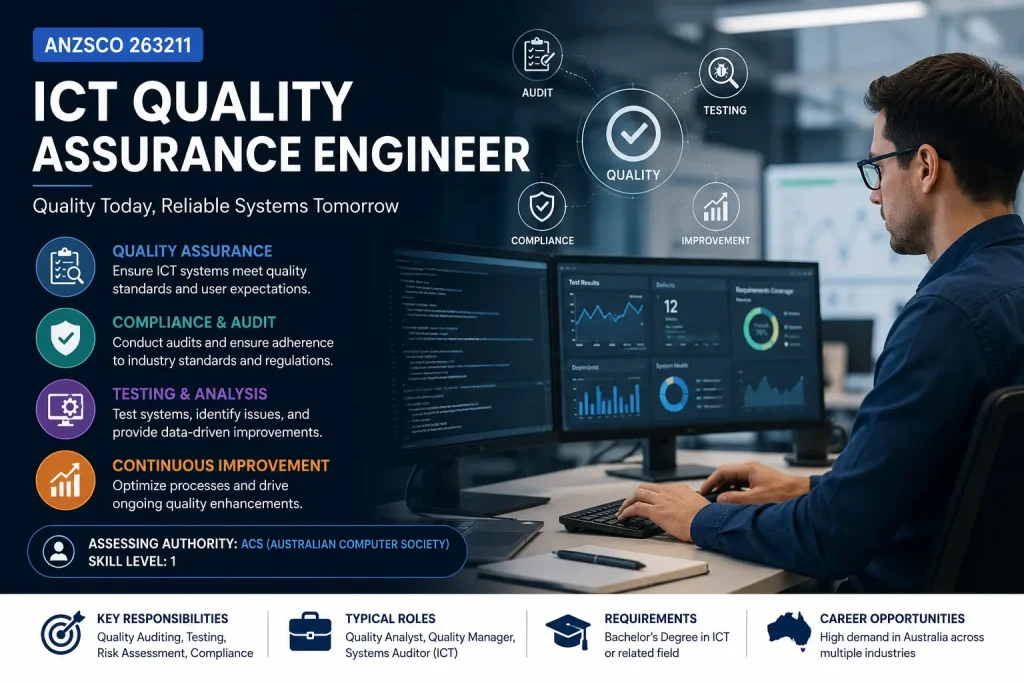
ICT Quality Assurance Engineer ANZSCO 263211 is a viable pathway for migration to Australia for those working in software quality assurance, system testing or technical auditing. ICT testing, quality control, compliance checks and system performance reviews are all occupations related to this occupation.
A lot of people confuse this role with Software Tester jobs. They are not identical, however. An ICT QA Engineer typically is involved with the entire process of system quality, standard, audits, testing and performance checks.
Home > ICT Quality Assurance Engineer
Quality Testing
Process Improvement
Defect Analysis
Compliance Verification
An ICT Quality Assurance Engineer checks whether computer systems, applications, and IT processes meet quality standards.
They test systems, appraise technical performance, assess risks and support companies to enhance software quality.
The position will also involve developing testing protocols and ensuring compliance with industry standards.
The classification for this job is ICT Support and Test Engineers under the ANZSCO classification.
The tasks you do each day can differ from one company to the next. There are some engineers who concentrate on testing. Others are focused more on audits and compliance.
Here are some common tasks:
Main Task | What It Means |
Create quality procedures | Build testing and QA processes |
Review systems | Check software performance and reliability |
Conduct audits | Inspect systems for quality compliance |
Identify risks | Find weak points or failures |
Prepare reports | Document testing and audit results |
Improve processes | Recommend fixes and upgrades |
Support testing teams | Help teams follow QA standards |
There are many that collaborate with developers, system engineers and project managers.
The official occupation description details this position as being about technical quality assurance systems and processes.
Some important skills include:
Soft skills matter too.
Effective communication is important when engaging with development teams and business managers.
Problem-solving is also essential. Since QA engineers are frequently engaged in uncovering errors in the system and performance problems.
This occupation falls under Skill Level 1 in Australia.
Category | Details |
Occupation | ICT Quality Assurance Engineer |
ANZSCO Code | 263211 |
Skill Level | 1 |
Group | ICT Support and Test Engineers |
Usually, applicants need a bachelor degree or strong ICT work experience.
Most applicants have:
While not all roles require an ICT degree, there is a pathway for people to obtain an ICT qualification via work experience and an RPL pathway.
For migration purposes, your occupation is assessed by the Australian Computer Society.
The ACS checks:
Your work tasks must closely match the duties of an ICT Quality Assurance Engineer.
Qualification Type | Typical Experience Needed |
ICT degree closely related | Around 2 years |
ICT degree not closely related | Around 4 to 6 years |
Non-ICT degree | More experience required |
No degree | RPL pathway usually needed |
Experience requirements can vary depending on your profile.
For migration purposes, your occupation is assessed by the Australian Computer Society.
The ACS checks:
Your work tasks must closely match the duties of an ICT Quality Assurance Engineer.
Qualification Type | Typical Experience Needed |
ICT degree closely related | Around 2 years |
ICT degree not closely related | Around 4 to 6 years |
Non-ICT degree | More experience required |
No degree | RPL pathway usually needed |
Experience requirements can vary depending on your profile.
The Recognition of Prior Learning pathway is used by many applicants for application.
This is typical for people with the following professions:
The RPL report usually includes:
Your projects should clearly show real ICT quality assurance work.
Many sites don’t do this.
National shortage information for this occupation is not as detailed as in other ICT occupations such as Software Engineer or Cyber Security Specialist.
There are no zero jobs, that doesn’t mean there are no jobs.
It just means the demand is more specific and depends on a few things:
Large companies still hire QA engineers for:
Employer-sponsored pathways are more feasible pathways for this occupation.
This occupation is generally connected with the STSOL pathway instead of the MLTSSL.
This alters the visa categories available.
Feature | STSOL | MLTSSL |
Subclass 189 access | Usually No | Yes |
State nomination | Yes | Yes |
Employer sponsorship | Yes | Yes |
Long term PR options | More limited | Stronger |
This is why many candidates tend to put emphasis on:
The standards for state nomination also can fluctuate.
Employer sponsorship can be important for ICT QA Engineers.
Common pathways include:
Visa Type | Purpose |
Subclass 482 | Temporary skilled work |
Subclass 186 | Permanent employer sponsorship |
Subclass 494 | Regional employer sponsorship |
Having a job offer can significantly enhance the prospects of migration.
Salaries are experience, tool, and industry dependent.
Finance, enterprise systems and cloud infrastructure workers tend to earn higher pay.
Experience Level | Estimated Salary |
Entry Level | AUD 75,000 to 90,000 |
Mid Level | AUD 90,000 to 115,000 |
Senior Level | AUD 120,000+ |
Employment opportunities can be boosted with automated testing and cloud QA skills.
QA engineers can be found in various industries.
Common industries include:
Some professionals also move into DevOps testing or cybersecurity compliance roles later.
People often mix these two occupations.
Both have some overlap, but each one has a different focus.
ICT QA Engineer | Software Tester |
Concentrates on complete QA systems | Focuses mainly on testing |
Handles audits and compliance | Executes test cases |
Builds QA procedures | Finds software bugs |
Reviews quality standards | Tests functionality |
Typically, an ICT QA Engineer will operate at a higher level in the process.
While in some instances, certifications may not be required, they can be beneficial.
Popular options include:
These can enhance employment options, as well as migration opportunities.
This job may have opportunities for advancement.
Possible career paths include:
Later, some specialists become cybersecurity auditors and compliance specialists as well.
This is a basic route:
Experience is important in this position.
Is ICT Quality Assurance Engineer the same as Software Tester?
Not exactly. QA Engineers typically work on Quality systems, standards and audits and Software Testers primarily on software testing activities.
Who assesses ANZSCO 263211?
The assessing authority is the Australian Computer Society.
Can I apply without an ICT degree?
Yes. The RPL pathway (work experience) is a popular choice for many applicants.
Is this occupation on the MLTSSL?
No. Generally linked to the pathways of STSOL.
What are some common visas for this profession?
The most popular visas are subclass 190, 491 and the employer sponsored visas.
Do certifications help for migration?
Certifications, such as ISTQB, can help enhance your profile, but are not required.
ICT Quality Assurance Engineer ANZSCO 263211 is a good option for professionals who enjoy testing systems, improving software quality, and solving technical issues.
Unlike some other ICT occupations, the migration pathway is a bit of a hybrid given its close connection to the STSOL pathway and employer-sponsored pathway.
Nevertheless, well-qualified and seasoned QA specialists can have a promising career in Australia, provided they develop the right skills, documentation and hands-on experience.
When you are interested in this particular field, emphasize real project work, QA processes, testing frameworks, and communication skills. Those areas are very important when applying for a job and during assessment reviews for ACS.
Save Up To
On your Skills Assessment!
Get Expert Guidence for your Migration Skills Assessment. Australia’s leading consultants for ACS, Engineers Australia and Vetassess and Others with a 99% success rate.
Extra Save
On Whatsapp order

Scan the QR Code with your mobile to get a Discount

Contact Us
Our Services
100% Secure
SSL Encrypted
4.9/5 Rated
We accept:
VISA
Mastercard
Stripe
Wise
PayPal
Disclaimer:
Copyright © 2020 – 2026 Skillassessmenthelp 98% Success | Trusted in 65+ Countries | 4.9/5 Rated | 100% Secure Payments


